What Is Skills-Based Learning? Why Companies Are Ditching Job Roles for Skill Maps
The job description is dying as the unit of workforce development. Something more precise, more useful, and more honest is taking its place: the skill.
Nearly eight in ten HR managers globally, 79%, say their company is now adopting a skills-based approach to hiring, training, and career development. That is not a fringe movement. That is a majority of the profession, in the middle of a structural shift that is changing how organisations think about talent, learning, and performance.
And yet most organisations' training programmes are still built around job roles. They onboard people into roles. They assign learning paths to roles. They assess performance against role descriptions. The role is the unit of everything.
The World Economic Forum projects that AI and related technologies will create approximately 170 million new roles globally while displacing roughly 92 million existing ones by 2030. The roles of 2026 will not be the roles of 2030. The companies that survive this transition will be the ones that built their people around skills, transferable, measurable, continuously developing capabilities- rather than around job titles that may not exist in four years.
This is the complete guide to skills-based learning: what it is, why the shift is happening, how to design a skills-based learning architecture, and how the right learning management system makes the whole thing work at scale.
1. What Is Skills-Based Learning?
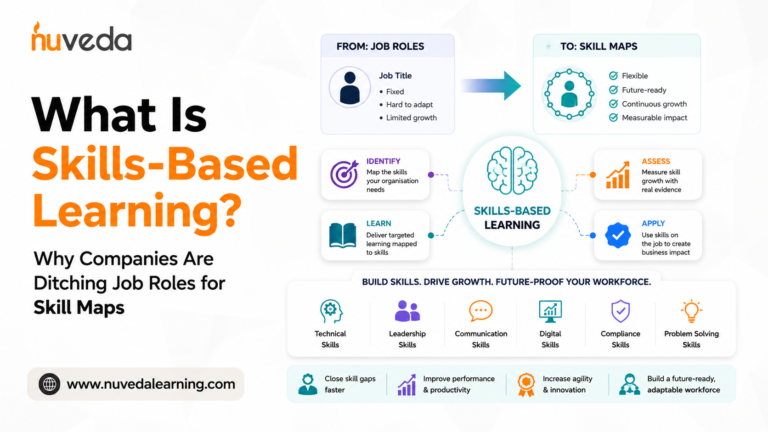
Skills-based learning is an approach to workforce development in which training, career pathing, and performance measurement are organised around specific, observable skills, rather than around job titles, roles, or qualifications.
In a traditional role-based system, the unit of organisation is the job: you are hired for a role, trained for a role, assessed against a role description, and promoted to the next role. Your development is defined by the boundaries of your current position.
In a skills-based system, the unit of organisation is the skill: a discrete, demonstrable capability, whether it is "clinical medication administration," "consultative selling," "data analysis in Python," "facilitation of difficult feedback conversations," or "FSSAI compliance auditing." These skills can be assessed, tracked, developed, and transferred across roles. They accumulate. They compound. And they remain valuable even when the role they were originally attached to changes or disappears.
A real skills-based learning platform does three connected things: it defines the skills a role requires, it delivers learning mapped to those skills, and it measures whether those skills actually grow, rather than just tracking course completions. That last clause is the whole game.
The difference between competencies and skills
"Skills" and "competencies" are often used interchangeably, but they are not identical:
- Skill, a specific, learnable capability: "can conduct a structured sales discovery call" or "can administer insulin safely." Narrow, observable, measurable.
- Competency, a broader cluster of related skills, knowledge, and behaviours: "customer centricity" or "clinical excellence." Wide, assessed through multiple evidence points.
Skills-based learning operates at the level of specific skills, because specific skills can be assessed, taught, practised, and verified with precision. Competency frameworks are useful for describing what great looks like. Skills frameworks are useful for developing it.
2. Why Job-Role Thinking Is Failing in 2026
The job role has been the fundamental unit of HR and L&D for over a century. Why is it failing now?
The pace of skill change has exceeded the pace of role change
LinkedIn research estimates that around 70% of the skills used in most jobs will change by 2030. Job titles change far more slowly than the skills those jobs require. A "Marketing Manager" in 2026 needs AI prompt engineering, data analytics, and generative content skills that did not exist in the Marketing Manager job description of 2022. The role name stayed the same. The skills required transformed completely.
When your learning system is built around role names, it cannot respond to this pace of change. When it is built around skills, updating it is surgical, you add the new skills, map them to the roles that need them, and deploy targeted development immediately.
Skills gaps are now the primary barrier to business transformation
63% of employers cite skills gaps as their biggest barrier to business transformation. Not budget. Not technology. Not strategy. Skills. And the skills gaps that matter most are not always in the obvious places, they are often invisible until an organisation tries to execute a strategic shift and finds that the people inside it do not have the capabilities to deliver it.
Role-based training systems cannot identify skills gaps with sufficient precision because they do not have skills as the unit of measurement. They know who completed what course. They do not know who can actually do what.
Skills are the new unit of organisational value
Deloitte's research into skills-based organisations — which surveyed over 1,200 professionals and business leaders — found that organisations are increasingly basing people decisions on skills rather than jobs, because skills are portable, precisely assessable, and compound over time in ways that job titles cannot. McKinsey's analysis reinforces the same shift: the organisations that invest in capability-building now are better positioned to fill critical roles faster, redeploy talent when disruption hits, and outcompete peers who are still anchored to role-based talent models.
AI is accelerating the obsolescence of role definitions
65% of executives expect 11–30% of their workforce to be redeployed or reskilled due to AI in the next two years. When that redeployment happens, the people who are easiest to redeploy are the ones whose skills are clearly mapped and documented, because it is easy to identify which of their existing skills transfer to the new role and which gaps need to be closed.
The people hardest to redeploy are the ones whose value is defined entirely by a job title, because when that title disappears, their demonstrated capability disappears with it. Skills-based organisations are building redeployment agility into their people infrastructure now, before the AI-driven displacement arrives.
3. Skills-Based Learning vs Traditional Training: The Key Differences
| Dimension | Traditional Role-Based Training | Skills-Based Learning |
|---|---|---|
| Unit of design | Job role or job family | Individual skill |
| Learning paths | Same for everyone in the role | Personalised to current skill level and gap |
| Assessment | Course completion | Demonstrated skill capability |
| Career development | Promotion up the role hierarchy | Skill accumulation and transfer across roles |
| Content assignment | Mandatory by role | Targeted by skill gap |
| Measurement | Completion rate | Skill growth rate |
| Adaptability | Slow, requires role redesign | Fast, update the skill, update the path |
| Visibility | Who completed what | Who can do what |
| Business alignment | Learning aligned to role descriptions | Learning aligned to business capability needs |
| AI compatibility | Low, roles are too broad for AI personalisation | High, skills are the natural unit for AI adaptation |
The single most important difference is the last column in "visibility." Traditional training systems tell you who attended the course. Skills-based systems tell you who can actually perform the skill, with evidence. That is a fundamentally different and more valuable piece of information.
4. The Business Case: What Skills-Based Organisations Actually Achieve
The shift to skills-based learning is not driven by ideology. It is driven by evidence of commercial outcomes.
Faster role-filling and internal mobility
Organisations with strong strategic workforce planning capability fill critical roles 17 days faster and experience 5.3 percentage points less annual turnover. When skills are clearly mapped and development is tracked against those skills, internal mobility decisions become data-driven rather than intuition-driven, which means the right people move to the right roles faster.
Expanded talent pools
LinkedIn data shows that skills-based hiring can expand the available talent pool by as much as 6.1 times, by opening roles to candidates who have the skills required, rather than the degree or title previously required. The same logic applies internally: when people are assessed on skills rather than role history, the internal talent pool available for any given opening multiplies significantly.
Better retention
88% of organisations are concerned about employee retention, and providing learning is the number one retention strategy. Skills-based development signals to employees that the organisation is investing in their long-term capability, not just training them to do the current job. That signal has measurable retention impact: 94% of employees say they would stay longer at a company that invests in their development.
Higher AI investment returns
Organisations taking a human-centric approach to AI are 1.6 times more likely to exceed their AI investment expectations. A human-centric AI approach requires knowing what human skills are needed alongside AI tools, which is only possible if you have a skills-first view of your workforce. Skills-based organisations are better positioned to extract value from AI investments because they can identify the human capability gaps that determine whether AI tools get used effectively.
5. Core Components of a Skills-Based Learning Architecture
Building a skills-based learning system requires five connected components. Most organisations have one or two. The ones producing the strongest outcomes have all five working together.
Component 1: A Skills Taxonomy
A skills taxonomy is a structured, organisation-specific catalogue of the skills that matter for your business, organised by category, level of proficiency, and relevance to specific roles and business functions.
A good skills taxonomy is:
- Specific enough to be meaningful, "communication" is too broad; "presenting financial data to non-finance stakeholders" is specific enough to be assessed and developed
- Role-mapped, every role in the organisation has a set of required skills with expected proficiency levels, so gaps can be identified by comparing current demonstrated skill to required skill
- Maintained, reviewed at least annually to add emerging skills (like AI tool proficiency) and retire obsolete ones
Component 2: Skill Assessment
Before you can develop skills, you need to know where people currently stand. Skill assessment can happen through:
- Formal assessment tools, structured tests, simulations, scenario-based assessments that provide objective capability evidence
- Multi-rater feedback, 360-degree feedback specifically designed to assess observable skill behaviours, not just general competency impressions (this is exactly what Nu360's AI-powered assessment framework is designed to deliver)
- Manager observation and conversation, structured conversations where managers assess their direct reports against specific skill criteria
- Performance data, operational metrics that serve as proxies for skill level (sales conversion rates, compliance incident rates, customer satisfaction scores)
Component 3: Personalised Learning Paths
Once skill gaps are identified, the learning system delivers targeted development, not the same course to everyone. A personalised path for a retail store manager identified as needing development in "coaching team members through underperformance conversations" looks completely different from a path for the same manager identified as strong in that skill but needing development in "data-led demand planning."
This personalisation is where the right enterprise LMS becomes critical. A platform like CALF™ that delivers adaptive, spaced learning paths aligned to specific skill gaps, rather than assigning uniform courses by role, is what makes personalised skills development scalable beyond small elite cohorts.
Component 4: Practice and Application
Skills are not developed by watching a video or reading a module. They are developed through practice, repeated, realistic, feedback-rich application of the skill in conditions that closely mirror the real job context.
This is where AI roleplay and simulation (like NuCoach.ai) adds its most significant value in a skills-based learning architecture. Rather than completing a course about how to handle a difficult conversation and hoping for the best, a learner can practise that exact conversation with an AI persona configured to respond with realistic complexity, and receive immediate, competency-specific feedback on exactly which aspects of their technique need refinement.
AI roleplay tends to be more immersive and real than standard e-learning, increasing knowledge retention and behaviour change, and it makes skills practice scalable across entire workforces rather than restricted to small groups who can access a human facilitator.
Component 5: Measurement Against Skill Growth, Not Completion
The final component is the measurement framework. And this is where the majority of organisations fail. They build a skills taxonomy, assess gaps, create learning paths, and then measure whether people completed the learning. Completion is not skill growth.
Skills-based measurement tracks: did the skill proficiency score actually improve? Did the improvement show up in on-the-job behaviour? Did it translate into a measurable business outcome? This is the Kirkpatrick model of training, Levels 3 and 4, applied specifically to skill development rather than generic training programmes.
A corporate training software platform that can measure skill growth over time, not just track module completions, is the foundation that makes skills-based learning visible, credible, and defensible in front of your CFO.
6. How to Build a Skills Map for Your Organisation
A skills map is the practical output of a skills taxonomy exercise: a visual or structured representation of which skills are needed, by whom, at what level, and where the gaps currently are.
Step 1: Define the skills that matter for your business strategy
Do not start with a generic skills framework. Start with your 3-year business strategy and ask: what capabilities do we need our people to have in order to execute it? An organisation entering new markets needs language, cultural adaptation, and business development skills. An organisation deploying AI tools needs AI literacy, prompt engineering, and data interpretation skills. An organisation scaling a healthcare training operation needs clinical simulation design, compliance documentation, and multi-site delivery skills.
Strategic skills first. Generic competencies second.
Step 2: Map skills to roles at multiple proficiency levels
For each identified skill, define what "foundational," "proficient," and "expert" looks like in observable, behavioural terms. Not "understands compliance principles" but "can accurately complete a GxP audit trail for a clinical trial documentation package." The specificity is what makes assessment and development possible.
Map each role to the skills it requires and the proficiency level expected. This becomes your skills-to-role matrix, the core architecture of your skills map.
Step 3: Assess current capability against the map
Using your assessment approach (formal tools, 360 feedback, manager observation, performance data), assess every individual against the skills their role requires. The output is a clear picture of your skills landscape: where you are strong, where you have gaps, and, critically, where you have hidden strengths in people whose skills have never been formally documented because they were assessed only by their job title.
Step 4: Prioritise gaps by business impact
Not all skills gaps are equal. A capability gap in a skill that is critical to a strategic initiative launching next quarter is more urgent than a gap in a skill that will not be needed for two years. Prioritise development investments based on the business impact of closing each gap, not on what is easiest to train.
Step 5: Build targeted learning paths for priority gaps
Design learning content and experiences specifically for the gaps that matter most. This is not about building a training programme for a job role. It is about building a development sequence for a specific skill, starting with knowledge, building to application, reinforcing with practice, and measuring the outcome.
Step 6: Track and iterate
A skills map is a living document. As business strategy evolves, as AI changes what skills are needed, and as individuals develop, the map changes. Build a review cadence, at minimum annually, ideally quarterly for fast-moving functions, that keeps the map current and the development investment aligned to what the business actually needs.
7. How AI Powers Skills-Based Learning at Scale
Skills-based learning is conceptually achievable without AI. But at scale, across hundreds or thousands of employees, dozens of roles, and hundreds of distinct skills, it is practically impossible to implement manually. AI is what makes it work.
AI-powered skill gap identification
Rather than relying entirely on manager assessment (which is subjective and inconsistent) or formal test scores (which capture knowledge but not application), AI-powered learning platforms can analyse multiple data sources simultaneously- assessment results, 360 feedback data, performance metrics, and learning engagement patterns- to build a more complete and accurate picture of current skill levels.
With the WEF projecting that 39% of core skills will change by 2030, the platforms that prove readiness rather than log hours are the ones that earn their budget.
AI-driven personalised learning path generation
Once skill gaps are identified, AI can generate personalised learning sequences, selecting from a library of content the specific modules, practice scenarios, and reinforcement activities most relevant to each individual's gap, at the right difficulty level, and delivered at the optimal spacing interval to maximise retention.
This is the difference between an AI learning platform and a content library with a search box. A content library shows you what is available. An AI learning platform tells you what you need, when to do it, and adjusts as you develop.
AI as the practice partner
Developing skills requires practice. AI roleplay and simulation tools make unlimited, on-demand skill practice available to every employee, not just the ones whose managers have time to role-play with them, or who can access a human coach. In a skills-based learning architecture, AI practice tools are the mechanism that converts learning content into demonstrated capability.
AI-powered skill measurement and reporting
AI can process performance data, assessment scores, and behavioural observation inputs simultaneously to generate a continuously updated picture of skill development across the organisation, at the individual, team, and organisational level. This gives HR and L&D leaders the data they need to report skills readiness to their board, identify where development is working, and catch skills gaps before they become business problems.
8. Skills-Based Learning Across Industries
Every industry benefits from a skills-based approach, but the priority skills and design implications differ significantly by sector.
Healthcare and Pharmaceuticals
In learning management systems for healthcare deployments, skills-based learning maps directly to clinical competency frameworks, the specific procedures, protocols, and professional behaviours that determine patient safety and care quality. A skills-based LMS can track which clinical staff are verified as competent in which specific skills, automate revalidation scheduling when certifications approach expiry, and flag competency gaps before they create compliance or safety exposure.
For pharmaceutical organisations, GxP compliance training becomes far more auditable when skills, not just course completions, are the unit of measurement. A regulatory auditor asking "can you demonstrate that your clinical trials staff are competent in GxP documentation?" is asking a skills question, not a completion question.
Retail
For LMS for retail applications, skills-based learning transforms frontline training from a completion exercise into a measurable capability-building programme. Rather than assigning "Product Knowledge Module 4" to all store associates and recording completion, a skills-based system assesses each associate's specific product knowledge gaps and delivers targeted micro-learning on their phone, in five-minute intervals, before the shift where they will need the knowledge.
The skill is "can accurately describe the key features and benefits of [product category X] in a customer conversation." The assessment can happen through a short scenario-based check. The practice happens through AI-powered product knowledge roleplay. The outcome is a verified, demonstrable capability, not a green tick on a completion dashboard.
Financial Services and BFSI
For compliance training LMS applications in financial services, skills-based learning means every compliance requirement maps to a specific, assessable skill, not just a training module. The difference matters when a regulatory body asks for evidence of competent practice, not just evidence of training attendance.
Non-Profits
For LMS for nonprofits contexts, skills-based learning enables impact reporting that goes beyond training activity: "our community health workers demonstrated measurable improvement in X clinical skill, validated through pre and post-assessment, and linked to Y improvement in patient outcomes in our programme areas." This is the kind of evidence that donor organisations and impact investors increasingly require.
Training Companies
For LMS for training companies, skills-based design transforms the product offering. Rather than selling "a two-day leadership workshop," a skills-based training company can sell "verified development of [specific leadership skills] measured before, during, and after the programme, with evidence of Kirkpatrick Level 3 impact." That is a fundamentally more defensible and differentiated product, and it commands significantly higher pricing.
9. How to Measure Whether Your Skills-Based Programme Is Working
The promise of skills-based learning is that it produces measurable capability growth, not just completed courses. Here is how to actually measure it.
Level 1: Skill proficiency change scores
Compare pre-programme and post-programme skill assessment scores for each skill targeted. This is the most direct measure of whether learning produced skill development. Look for improvements of at least 20–30% on the assessment scale to indicate meaningful skill growth (smaller improvements may reflect assessment variance rather than real capability change).
Level 2: Behavioural evidence on the job
Skill proficiency scores measure what people know and can demonstrate in an assessment context. Kirkpatrick Level 3 measurement, manager observation, LAP completion, 360-degree feedback specifically targeting the developed skills, measures whether the skill shows up on the job, in real situations, under normal operating conditions. This is the evidence that skills-based learning actually changed behaviour, not just assessment performance.
Level 3: Business outcome correlation
The strongest evidence for a skills-based learning programme is a demonstrable link between skill development and a business metric: compliance incident rates down after GxP skill development; sales conversion rates up after consultative selling skill programme; customer satisfaction scores improved after complaint-handling skill training; time-to-competency reduced for new hires after skills-based onboarding redesign.
This level of measurement requires your training management system to integrate with operational data, which is why choosing an LMS with HRMS and performance system connectivity is a strategic decision, not just a technical one.
Level 4: Skill coverage and readiness reporting
At the organisational level, track what percentage of your workforce meets the required proficiency level for each critical skill. "Skills coverage", the proportion of people who are verified competent in a critical skill, is the metric that most directly answers the question "are we ready to execute our business strategy?"
Only 36% of organisations qualify as career development champions with robust programmes in place, despite 91% of L&D professionals agreeing that continuous learning is more important than ever. The gap between aspiration and execution is where skills coverage reporting does its most important work: making the gap visible, so that resources can be deployed to close it.
10. How NuVeda's Ecosystem Enables Skills-Based Learning End to End
NuVeda Learning's product suite, Nu360, CALF™, and NuCoach.ai, maps directly onto the five components of a skills-based learning architecture. This is not coincidence: CALF™ (Continuous Application of Learning Feedback) was built on the conviction that feedback, specific, continuous, competency-level feedback, is what makes learning translate into real capability growth.
Nu360, Assess
Nu360's AI-powered 360-degree feedback framework provides the skills assessment layer: multi-rater, observable-behaviour-based assessment of specific competencies, generating the data that tells you where each individual is strong and where they have development needs.
Unlike generic 360 tools that assess broad competency impressions, Nu360's reports are designed to be specific and actionable, identifying the precise skill areas where development investment will produce the greatest capability gain. This is the "assess" in Assess → Learn → Grow.
CALF™, Deliver personalised, measurable learning
CALF™ is NuVeda's AI-powered LXP/LMS, the platform that takes the skills gaps identified by Nu360 and delivers targeted, personalised, spaced learning to close them.
For lms for corporate training applications, CALF™ manages the full delivery lifecycle: instructor-led, self-paced, and blended programmes across web, tablet, iOS, and Android (including offline access for frontline workers in healthcare, retail, and logistics environments). Learning paths are mapped to specific skills, not generic role profiles, so every hour of learning time is directed at closing an identified gap, not covering content that may or may not be relevant.
Built-in Kirkpatrick Level 3 and Level 4 measurement means skills development is tracked all the way from learning activity through to on-the-job behaviour change and business outcome, which is the only evidence chain that proves a skills-based programme is working.
For lms for training companies, CALF™'s multi-tenant, white-label architecture means professional training organisations can deliver skills-based programmes to multiple clients simultaneously, each with their own branded portal, their own skills framework, and their own measurement dashboard, while managing everything from a single administrative interface.
NuCoach.ai, Convert learning into demonstrated capability
NuCoach.ai provides the practice layer: contextual AI roleplay and simulation that lets learners practise the specific skills they are developing in realistic, job-role-specific scenarios with immediate, competency-specific feedback.
This is where the skills development journey completes its cycle. Nu360 identifies where the gap is. CALF™ delivers the knowledge and structured development. NuCoach.ai provides the repeated, feedback-rich practice that converts knowledge into demonstrated capability, the skill as it actually shows up under pressure, in a real conversation, in the real job.
The Assess → Learn → Grow cycle is not a marketing slogan. It is a closed-loop skills development architecture that addresses all five components: taxonomy (built into the programme design), assessment (Nu360), personalised paths (CALF™), practice (NuCoach.ai), and measurement (Kirkpatrick integration in CALF™).
11. Frequently Asked Questions
What is skills-based learning?
Skills-based learning is an approach to workforce development in which training, assessment, and career development are organised around specific, observable skills rather than job titles or role descriptions. Instead of assigning the same course to everyone in a role, skills-based learning identifies each individual's current skill level, closes the specific gaps that matter for their role and the business strategy, and measures whether skills actually improved, not just whether courses were completed.
What is the difference between skills-based learning and competency-based learning?
Competency-based learning organises development around broad competency clusters (like "communication" or "leadership"). Skills-based learning operates at a more specific level, targeting discrete, learnable, assessable capabilities like "can conduct a structured customer needs analysis" or "can administer insulin safely." Skills are more precisely measurable and more directly developmental than competencies, which makes them better suited to personalised learning design and business-impact measurement.
Why are companies moving to skills-based learning in 2026?
Several forces are converging: the WEF projects that 39% of core skills will change by 2030, making role-based training systems too slow to keep pace; 63% of employers cite skills gaps as their biggest barrier to transformation; AI is displacing some roles while creating demand for new skills, and organisations need to redeploy people faster than role-based systems allow. Skills-based approaches give organisations the agility and precision to respond to these forces.
How do you assess skills in a skills-based learning programme?
Skills assessment combines multiple evidence sources: formal scenario-based assessments that test capability in realistic conditions; 360-degree feedback that captures observable skill behaviours from multiple rater groups; manager observation against specific skill criteria; and operational performance data that serves as a proxy for skill proficiency. The most accurate skills assessment uses all four sources rather than relying on any single method.
What is a skills taxonomy?
A skills taxonomy is a structured, organisation-specific catalogue of the skills that matter for your business, organised by category, proficiency level, and relevance to specific roles. It is the foundation of a skills-based learning system, the master list against which every individual is assessed, every learning path is designed, and every development investment is justified. A good skills taxonomy is specific enough to assess precisely, role-mapped to identify gaps, and maintained regularly to reflect changing business needs.
What role does an LMS play in skills-based learning?
A learning management system is the delivery and measurement infrastructure for skills-based learning. The right LMS maps learning content to specific skills, delivers personalised paths based on individual skill gaps, tracks skill development over time (not just module completion), integrates with 360 feedback and HRMS systems, and provides Kirkpatrick Level 3 and 4 measurement that connects skill development to on-the-job behaviour and business outcomes. Not all LMS platforms can do this, look specifically for platforms that support skill-tagged content and skill growth reporting.
How is CALF™ different from a standard LMS for skills-based learning?
CALF™ (Continuous Application of Learning Feedback) was built around the principle that continuous, competency-level feedback is what converts learning into real capability growth. Unlike standard LMS platforms that track course completion, CALF™ maps learning paths to specific skills, delivers spaced and personalised content, integrates Learning Action Plans that bridge training to on-the-job application, and measures skill development through built-in Kirkpatrick Level 3 and Level 4 reporting. Combined with Nu360 for skills assessment and NuCoach.ai for skill practice, CALF™ enables a complete skills-based learning architecture, not just a content delivery platform.
What is the Kirkpatrick model and why does it matter for skills-based learning?
The Kirkpatrick model of training evaluation measures training effectiveness at four levels: Reaction (did learners find it relevant?), Learning (did they acquire the skill?), Behaviour (did their behaviour change on the job?), and Results (did it produce measurable business outcomes?). For skills-based learning, Levels 3 and 4 are the critical measures, because they are the only evidence that skills development actually translated into changed performance. A learning system that only measures Level 1 and 2 (satisfaction and assessment scores) cannot tell you whether your skills-based programme is working.
The Bottom Line
The shift from role-based to skills-based learning is not a trend. It is a structural response to a structural challenge: the pace of skill change has outrun the pace of role evolution, and the organisations that fail to close the gap will find themselves unable to execute their own strategies.
As Deloitte's research into skills-based organisations makes clear, the organisations creating the most value are those that have decoupled people decisions from job titles — and anchored them to skills instead.
Building a skills-based learning architecture requires five components working together: a skills taxonomy, reliable assessment, personalised learning paths, practice and application opportunities, and measurement that tracks skill growth rather than course completion. The organisations putting all five in place are the ones producing outcomes that matter, faster internal mobility, stronger retention, higher AI investment returns, and the workforce agility to respond to changes that cannot yet be predicted.
The right AI-powered learning platform is the infrastructure that makes all five components work at scale, connecting assessment data to personalised paths, paths to practice, and practice to measurable business outcomes in a closed loop that continuously improves.
Ready to see how skills-based learning works in practice across your industry? Book a free 30-minute CALF™ demo and explore how the NuVeda ecosystem connects assessment, learning, and practice into a complete skills development architecture.