
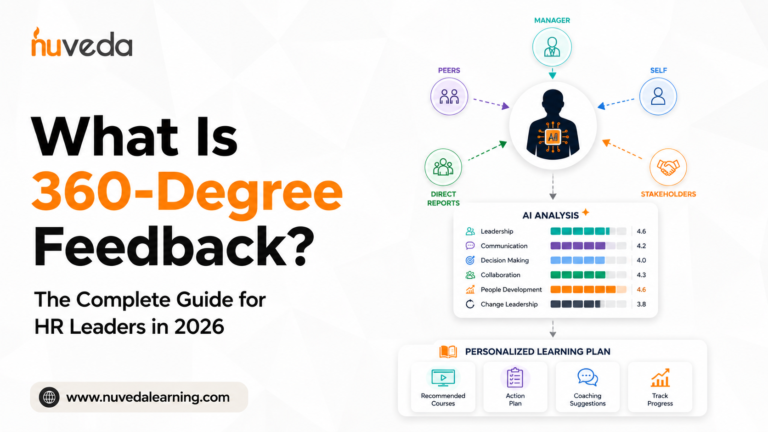
What Is 360-Degree Feedback? The Complete Guide for HR Leaders in 2026
The annual performance review is dying. And 360-degree feedback is filling the gap, but only when it's done right. Across organisations in 2026, HR leaders are grappling with the same set of questions: How do we give managers development data that's actually honest? How do we break the "only the boss's opinion counts" dynamic that distorts performance conversations? And how do we connect feedback to real behaviour change, not just an annual report that sits in a drawer? 360-degree feedback, when designed correctly and supported by the right tools, is the most powerful instrument available for answering those questions. When designed poorly, which is most of the time, it produces expensive cynicism and nothing else.
1. What Is 360-Degree Feedback?
360-degree feedback, also known as multi-rater feedback or multi-source assessment, is a structured process in which an individual receives performance and behaviour feedback from multiple perspectives simultaneously: their direct manager, their peers, their direct reports, and sometimes external stakeholders such as clients or partners. The individual typically also completes a self-assessment.
The "360 degrees" refers to the full circle of perspectives: above, below, beside, and within the individual. Unlike a traditional performance review, where a single manager's perspective defines the entire assessment, 360-degree feedback captures how a person is experienced by everyone they work with.
The purpose is almost always developmental: to give people a richer, more accurate picture of their strengths and blind spots than a single-source review can provide, and to use that insight to drive targeted professional development.
Research consistently shows that 50% of leaders demonstrably improved their behaviour after receiving multi-rater feedback, and organisations that use 360 feedback regularly see up to 15.9% better employee retention among individuals who receive it.
What 360 feedback is not
It is worth being clear about what 360-degree feedback is not, because the misuse of the process is one of the primary reasons so many programmes fail:
- It is not a replacement for performance appraisal; using 360 results to make compensation or promotion decisions is consistently shown to reduce the honesty and quality of feedback, because raters begin gaming the system rather than giving candid developmental input
- It is not a one-time event; a single 360 survey, without follow-up development planning and repeat measurement, produces data but not change
- It is not a vote on whether someone is liked; the competencies assessed must be observable, job-relevant behaviours, not personality traits or interpersonal popularity
2. How 360-Degree Feedback Works: The Process Step by Step
A well-designed 360-degree feedback process follows a clear sequence. Here is what each stage involves and what makes the difference between a programme that drives change and one that generates a report nobody reads.
Before writing a single question, HR leaders need to define precisely what the 360 is designed to measure and why. The competencies assessed must be:
- Observable, things that can actually be seen in someone's day-to-day behaviour
- Relevant, directly connected to the skills and behaviours the organisation needs at this career level
- Shared, understood the same way by all rater groups
Rater selection is one of the most consequential decisions in the process. Too few raters and the data is not statistically meaningful. Too many and you risk survey fatigue and diluted responses. The typical guidance:
- Direct manager: 1 (always included)
- Peers: 4–8 (enough for pattern recognition, small enough to maintain anonymity)
- Direct reports: 3–6 minimum for meaningful upward feedback; fewer than 3 risks de-anonymising responses
- Self: always included, the gap between self-perception and others' perception is often the most actionable data
Most effective leadership 360 surveys include 15–25 questions split across 5–7 leadership competencies. Fewer than 15 misses important dimensions, while more than 30 leads to survey fatigue and rushed responses. Aim for 3–4 questions per competency, with a mix of rating-scale and open-ended formats. Every question must be:
- Written about a specific, observable behaviour, not a trait or a general impression
- Understandable by all rater groups, without HR jargon or role-specific technical language
- Neutral in direction, avoiding leading questions that suggest the "correct" answer
Surveys are distributed and collected anonymously through a 360 feedback platform. Key operational requirements:
- Automated reminders that drive completion without manual follow-up
- Real-time completion tracking for HR administrators
- Anonymity controls that prevent individual responses from being traced back to specific raters
- Mobile-friendly survey design; clunky, overly long, or confusing surveys lead to low response rates and unreliable data
Feedback reports should always display self- and others' perceptions side by side visually, not just as numerical values. Debrief conversations should ideally start with the leader's own self-assessment before showing others' perceptions. Strong overestimations should never be delivered without professional support; a coach or HR business partner is essential.
Reports need to translate data into readable, actionable insight, not raw scores that require an analytics degree to interpret. The best 360 software generates reports that identify:
- Clear strengths (consistent high ratings across rater groups)
- Development areas (consistent low ratings or high variance)
- Blind spots (areas the individual rates themselves significantly higher than others do)
- Hidden strengths (areas others rate higher than the individual rates themselves)
This is where the majority of 360 programmes fail. Without a structured process for connecting feedback results to a concrete development plan, and then following up on that plan, the 360 becomes an expensive data-collection exercise. The individual, their manager, and ideally an HR business partner or coach should review results together, agree on 2–3 priority development areas, and build a Learning Action Plan with specific, observable commitments and a timeline for review.
3. 360-Degree Feedback vs Traditional Performance Reviews
| Dimension | Traditional Performance Review | 360-Degree Feedback |
|---|---|---|
| Number of raters | 1 (direct manager) | 5–15+ (manager, peers, reports, self) |
| Perspective | Top-down only | Multi-directional |
| Primary purpose | Evaluation and compensation | Development and behaviour change |
| Frequency | Annual or bi-annual | Flexible, quarterly, annual, or event-based |
| Honesty level | Often limited by power dynamic | Higher (when anonymity is well-designed) |
| Blind spot visibility | Low | High |
| Leadership development value | Limited | Very high |
| Risk of misuse | Bias, recency effect | Gaming, if tied to compensation |
| Data richness | Single perspective | Multi-perspective patterns |
| Action orientation | Often retrospective | Forward-looking and developmental |
In 2026, too many organisations are still running 360 reviews the same way they ran them in 2005, using them as part of performance reviews rather than as standalone employee development opportunities, and wondering why nothing improves.
The evidence strongly supports keeping 360 feedback separate from compensation and promotion decisions. When raters know their responses might influence someone's salary, candour drops and the developmental value of the process collapses.
4. The Real Benefits of 360-Degree Feedback, and the Evidence Behind Them
When properly designed and followed through, 360-degree feedback produces outcomes that no other single development intervention can match.
The gap between how leaders see themselves and how they are experienced by those around them is one of the most consistent findings in organisational psychology. Multi-source feedback leads to greater behavioural change than single-source feedback alone, particularly when follow-up and accountability structures are in place. Seeing that gap in black and white, especially when it is confirmed across multiple rater groups, creates a cognitive disruption that is far more motivating than being told by a single manager that "you could communicate better."
For organisations developing large populations of managers and future leaders, 360 feedback provides the personalised, multi-perspective developmental insight that individual coaching conversations cannot generate at scale. Every manager gets a clear picture of their specific development priorities, not a generic leadership model applied uniformly across the group.
When direct reports know their feedback is genuinely anonymous and genuinely considered, the quality and honesty of upward communication improves over time, not just in formal 360 surveys, but in day-to-day working relationships. Leaders who receive and respond constructively to downward feedback create teams where people feel safer to raise problems early.
360 feedback data, aggregated across a leadership population, reveals patterns that are invisible at the individual level, which competencies are systematically underdeveloped across a management cohort, which emerging leaders are consistently rated highly by their peers and reports but overlooked by their managers, and where the organisation's leadership pipeline is strong or fragile.
The most powerful application of 360 feedback is as the first step in a connected development journey. A well-designed 360 tells you where someone needs to develop. A connected learning management system delivers the training content. An AI coaching platform provides the practice and reinforcement. This is the Assess → Learn → Grow model that NuVeda's full product suite, Nu360, CALF™, and NuCoach.ai, is designed to operationalise end to end.
5. Why Most 360 Feedback Programmes Fail
The gap between the potential of 360-degree feedback and the experience most organisations have with it is significant. Understanding why programmes fail is as important as understanding what they should achieve.
"Is this person a good communicator?" is not a useful 360 question. It asks raters to make a global personality judgement, and different raters will interpret "good communicator" in completely different ways. A behavioural question is specific: "When presenting to senior stakeholders, this person communicates key messages clearly and concisely." That is observable. It is answerable consistently across rater groups. It produces data that can be acted on.
When a manager has only two direct reports completing the upward feedback survey, those two respondents know that any response they give could potentially be identified. Perceived anonymity is destroyed. Response honesty collapses. The platform must prevent completion of any rater group with fewer than 3 respondents, and must present results in a way that prevents pattern-matching to individual raters.
360 feedback without follow-through creates cynicism. Organisations that run 360 programmes without a structured, mandatory follow-up process, a debrief with an HR business partner, a written development plan, a manager conversation within 30 days, consistently report that employees regard subsequent 360 cycles with increasing scepticism. "We did this last year and nothing changed" is the death sentence for a 360 programme.
When 360-degree feedback is linked to performance ratings or compensation decisions, willingness to give honest, critical feedback typically drops significantly. HR professionals should clearly communicate and protect the developmental purpose of the instrument.
Running a 360 once a year captures a snapshot. It does not track whether development is actually happening between cycles. The most effective programmes in 2026 use a combination of annual deep-dive 360 assessments and lighter-touch quarterly pulse checks, giving managers more frequent feedback signals without the administration burden of a full multi-rater process every quarter.
The most common single failure in 360-degree feedback programmes is treating the generation of the report as the end of the process. It is not. The report is the starting point. The development plan is the process. Behaviour change on the job is the outcome. And measurement of that behaviour change, at Kirkpatrick Level 3, is the only real evidence that the 360 programme is working.
6. 360-Degree Feedback Questions: Examples by Competency
The quality of a 360 feedback programme is determined more by the quality of its questions than by any other single factor. Below are example questions across the six competencies most relevant to leadership and management development.
- When sharing complex information, this person explains key points in a way that different audiences can understand
- This person actively listens and demonstrates understanding before responding to colleagues
- When giving instructions or setting expectations, this person ensures clarity without the need for repeated follow-up
- In high-stakes or difficult conversations, this person communicates with confidence and appropriate directness
- This person makes timely decisions, even under conditions of uncertainty or incomplete information
- Before reaching conclusions, this person gathers input from relevant stakeholders
- This person can distinguish between decisions that require consensus and those they should make independently
- When a decision proves to be wrong, this person acknowledges it and adjusts course without defensiveness
- This person provides regular, specific, and constructive feedback that helps their team members improve
- This person identifies and creates opportunities for team members to develop new skills
- This person spends time coaching team members on an individual level, not just directing group activities
- Team members who report to this person feel supported in pursuing their professional goals
- This person sets clear expectations and holds themselves and others to commitments
- When this person makes a commitment, they consistently follow through on it
- This person takes personal responsibility for outcomes, positive and negative, rather than deflecting
- This person gives team members the authority they need to own their work fully
- This person builds productive relationships across teams and functions, not just within their own group
- When this person needs support from colleagues outside their direct authority, they achieve it through influence rather than hierarchy
- This person shares relevant information proactively with colleagues who would benefit from it
- In cross-functional projects, this person is regarded as a constructive and reliable partner
- This person articulates the rationale for organisational change in a way that reduces anxiety and builds commitment
- When facing resistance to change, this person addresses concerns directly rather than dismissing them
- This person adjusts their approach when a plan is not working, without waiting to be told
- This person maintains team productivity and morale during periods of significant uncertainty
- "What is this person's single greatest professional strength?"
- "What is the one behaviour change that would make this person significantly more effective?"
- "Is there anything important about this person's leadership that the questions above did not capture?"
7. Who Should Participate? Rater Groups Explained
Understanding what each rater group uniquely contributes, and where each is limited, is essential for designing a 360 that produces trustworthy data.
- Direct Manager: Provides context on strategic performance, goal alignment, and observed behaviour in senior settings. Has the most complete picture of results but often the least visibility into team dynamics and day-to-day peer relationships. Should be weighted appropriately, not allowed to dominate results in a programme designed around multi-rater insight.
- Peers: Provide unique visibility into collaboration style, cross-functional reliability, communication in informal settings, and the leadership behaviours that appear outside manager observation. Often the most candid rater group. Most valuable for identifying blind spots that managers cannot see.
- Direct Reports (Upward Feedback): The highest-value rater group for leadership development, and the one most organisations handle most poorly. Direct reports see leadership behaviours every day that managers never observe: how someone handles team meetings, how they respond to errors, how they give informal feedback, how they behave under pressure. Protecting genuine anonymity for this group is non-negotiable.
- Self-Assessment: Completing a self-assessment before seeing others' ratings is the most important step in the debrief process. The gap between self-perception and multi-rater consensus is often the data that generates the strongest commitment to change.
- External Stakeholders (Optional): Clients, suppliers, or internal customers from other business units can add valuable perspective on relationship management, communication, and responsiveness, particularly for client-facing roles or business development functions.
8. How AI Is Changing 360-Degree Feedback in 2026
In 2026, artificial intelligence is fundamentally changing what is possible in 360-degree feedback, across survey design, report generation, and the connection between feedback and development.
A startup running a hyper-growth phase needs different leadership questions than a 200-person scale-up navigating product-market expansion. This is where AI-powered 360 platforms create real differentiation; instead of forcing HR teams to manually rewrite generic templates, AI generates role- and context-specific question sets aligned to the organisation's competency framework.
Open-ended questions in 360 surveys produce rich qualitative data, but historically that data has been difficult to analyse at scale. AI-powered platforms can now process free-text responses across hundreds of raters and surfaces consistent themes, recurring language patterns, and sentiment signals that would take an HR analyst days to identify manually.
Rather than presenting leaders with a 40-page report of scores and graphs, AI platforms can generate a readable narrative summary of the key findings, identifying the most significant strengths, the highest-priority development areas, and the most striking gaps between self-perception and multi-rater feedback, in plain language that is actionable rather than overwhelming.
Connected to a learning management system and coaching platform, an AI-powered 360 tool can automatically recommend specific learning resources, coaching conversations, and practice scenarios based on the individual's 360 results. This closes the gap between insight and action that is the primary reason 360 programmes fail.
AI is enabling the shift from annual 360 assessments to continuous micro-feedback cycles, short, frequent check-ins that give managers a real-time signal of how they are being experienced, without the administrative burden of a full multi-rater survey. Combined with annual deep-dive assessments, this creates a development feedback loop that keeps learning continuous rather than episodic.
9. How to Choose the Right 360 Feedback Software
The 360 feedback software market is crowded in 2026. Here is what actually matters when evaluating options, beyond feature checklists and vendor demos.
Must-have features- Survey customisation: The platform must allow you to build or customise surveys against your own competency framework, not just use a generic template. Every organisation's leadership model is different. Generic questions produce generic insights.
- Genuine anonymity controls: The platform must enforce minimum rater group sizes and present results in formats that cannot be traced back to individual respondents. Ask the vendor specifically: "What prevents a rater from being identified?" If they cannot give you a precise technical answer, the anonymity is insufficient.
- Report quality: Raw scores without context do not help managers understand what to actually change. Reports must present data visually, highlight the most actionable patterns, and be readable by the feedback recipient without HR support. Request sample reports before committing.
- Development plan integration: Feedback that isn't connected to a next step rarely leads to real development. Action planning capabilities should be native to the platform, not an afterthought that requires exporting results to a separate tool.
- Automated reminders and completion tracking: Manually building rater groups, tracking responses, and compiling reports eats up HR time and slows the whole process down. The platform should automate all of this, with configurable reminder cadences and real-time completion visibility for administrators.
- HRMS integration: The platform should connect to your HRMS and, ideally, to your learning management system, so that 360 results flow directly into development planning and learning recommendations without manual data transfer.
- Mobile-friendly design: A significant proportion of raters will complete surveys on their phone. Mobile-unfriendly survey design is the single fastest way to kill completion rates and data quality.
- "What is the minimum rater group size before responses are suppressed?"
- "Show me an example report from a recent client, not a mock-up"
- "How does the platform connect 360 results to development planning?"
- "What does the debrief workflow look like for the feedback recipient?"
- "Can you show me how AI is used in the platform, specifically?"
- "What integrations exist with LMS and HRMS platforms?"
10. How Nu360 by NuVeda Brings AI to 360 Feedback
Nu360 is NuVeda Learning's AI-powered 360-degree feedback platform, designed to address the two failures that consistently undermine traditional 360 programmes: reports that nobody understands, and insights that never translate into action.
Nu360 generates reports that are designed to be read and understood by the feedback recipient, not just by HR professionals with a background in psychometrics. AI-powered insight summaries translate multi-rater scores into clear, prioritised, plain-language development guidance. The gap between self-perception and multi-rater feedback is visualised in a format that makes the insight immediate and compelling.
Survey completion rates are one of the most consistently under-managed quality factors in 360 programmes. A survey that takes 40 minutes and requires desktop access will not get completed. Nu360 is designed for fast, mobile-friendly completion, keeping surveys focused on the most impactful questions and making the experience straightforward for every rater group.
This is Nu360's most significant differentiator in 2026. Most 360 platforms stop at the report. Nu360 connects directly to CALF™, NuVeda's AI-powered LXP/LMS, so that feedback results flow into personalised learning journeys automatically.
The sequence: a manager receives their Nu360 report, identifies communication as their highest-priority development area, and is automatically enrolled in a targeted learning path in CALF™, with spaced reinforcement, Learning Action Plans, and Kirkpatrick Level 3 measurement built in. NuCoach.ai then extends that learning with contextual AI roleplay scenarios that let the manager practise the specific communication behaviours they are developing, in a safe environment that mirrors their real job context.
This is what the Assess → Learn → Grow model looks like in practice:
- Assess: Nu360 identifies the specific development priorities with multi-rater evidence
- Learn: CALF™ delivers personalised, spaced, measurable learning content
- Grow: NuCoach.ai provides AI-powered practice and behavioural reinforcement
11. Frequently Asked Questions
360-degree feedback is a performance and development process in which an employee receives structured, anonymous feedback from multiple sources: their direct manager, peers at the same level, direct reports, and a self-assessment. The "360 degrees" refers to the full circle of perspectives. It is primarily used for leadership development and identifying professional growth priorities, rather than for performance evaluation or compensation decisions.
A traditional performance review is conducted by a single manager and is typically linked to compensation and promotion decisions. 360-degree feedback collects input from multiple rater groups and is designed for development, giving individuals a broader, more honest picture of their strengths and blind spots than a single manager can provide. Experts consistently recommend keeping 360 results separate from pay and promotion decisions to protect feedback honesty.
A typical 360 process includes the feedback recipient's direct manager, 4–8 peers, 3–6 direct reports, and a self-assessment. For customer-facing roles, external stakeholders may also be included. The minimum rater group size for each category is typically 3, to protect anonymity of individual responses.
Good 360 questions are specific, observable, and behavioural, describing what someone does, not what kind of person they are. Questions should be organised by competency (communication, decision-making, people development, accountability, collaboration, change leadership) and should be answerable by all rater groups in plain language. Aim for 15–25 questions total, plus 2–3 open-ended qualitative questions.
Most organisations run a full 360-degree feedback process annually or bi-annually for leadership development. Some supplement this with lighter-touch quarterly pulse check-ins. Running 360 feedback more than twice a year with the full multi-rater format typically leads to survey fatigue and declining data quality.
No. Research consistently shows that linking 360 feedback to compensation or promotion decisions reduces the honesty and quality of feedback, because raters begin gaming their responses strategically rather than providing candid developmental input. 360 feedback should be explicitly and consistently positioned as a development tool, not an evaluation instrument.
The most common and costly mistake is treating the feedback report as the end of the process. Generating a 360 report without a structured development planning follow-up, a debrief conversation, a written development plan with specific commitments, and a scheduled review consistently produces cynicism rather than change. Development planning integration is the most important feature to look for in 360 feedback software.
AI 360 feedback refers to the use of artificial intelligence within the 360-degree feedback process, for customising survey questions to specific roles and competency frameworks, processing qualitative open-text responses at scale through natural language processing, generating readable insight summaries rather than raw score reports, and recommending personalised development resources connected to feedback results. AI-powered 360 platforms like Nu360 by NuVeda can also connect feedback results directly to personalised learning journeys in an LMS, closing the gap between insight and action.
The most effective use of 360-degree feedback connects results directly to a personalised learning journey, with the 360 assessment identifying the development priorities, a learning management system delivering targeted content, and coaching or practice tools reinforcing new behaviours on the job. NuVeda's integrated product suite, Nu360, CALF™, and NuCoach.ai, is specifically designed to operationalise this Assess → Learn → Grow cycle.
The Bottom Line
360-degree feedback is not a survey. It is not a report. It is the first step in a development journey, and its value is entirely determined by what happens after the data is collected.
HR leaders who get 360 right in 2026 are the ones treating it as an input to a continuous development cycle, not a periodic compliance ritual. They are choosing platforms with AI-powered insight generation and direct integration with learning tools. They are separating feedback from compensation, protecting rater anonymity rigorously, and building structured debrief and development planning processes that make sure insights translate into changed behaviour.
The organisations doing this well are building leadership pipelines that are measurably stronger than those of competitors still relying on annual manager reviews alone. The data on behaviour change, retention, and leadership effectiveness consistently favours the multi-rater approach, when it is executed properly.
Ready to see what AI-powered 360 feedback looks like in practice? Book a free demo of Nu360 by NuVeda and see how it connects with CALF™ and NuCoach.ai to drive real behaviour change, not just better reports.