
The Advent of the Learning Scientist — Part 1
As a theoretical physicist, I was building neural networks decades before the current AI wave. I was trained to propose ideas that might be wrong and then trained as a Six Sigma Master Black Belt in GE to eliminate variance from processes that were. Most enterprises have built the second capability thoroughly but not the first one.
Many executive leaders continue to treat learning and development as a cost center. That is a strategic error. Learning is one of the key engines of competitive strategy and organizational innovation. In today’s world, enterprises need a role that does not yet exist in most organization charts: the Learning Scientist.
Let me define the term for precision.
A Learning Scientist is a professional who cross-references an organization’s proprietary data in terms of performance, capability, revenue, cost, attrition, etc., to identify where capability is creating or destroying business value, and who converts those inferences into decisions the business can act on.
This is not a trainer, not an instructional designer, not a reporting or a data analyst. This is someone whose output is a strategic recommendation for the company as a whole.
The paradigm shift
It’s a paradigm shift for business leaders; on the one hand, you have innovations taking place at break-neck speed while the need to look at broad industry trends and research takes time and lots of data to analyze. Today’s competitive business landscape demands both because it is easy to play the copy cat and stay in the game; however, real growth and innovation needs the ability to cross-reference data and generate inferences that can contribute to innovations that are real money spinners.
For example, consider the current evolution of global infrastructure. To power the AI boom, demand for data storage has reached critical levels, which has led to bold initiatives such as the exploration of space-based data centers to get past terrestrial limits. The hyperscalers are spending extraordinary sums to decide where to put their data. Most other enterprises are spending nothing at all on who interprets theirs.
That is the asymmetry I want leaders to wrestle with. Physical infrastructure is only half the equation. AI may generate infinite content, but at least currently, it does not have the intuition required to interpret proprietary data and forge a corporate strategy from it. The race for space-based data centers is a physical moat. The Learning Scientist is the intellectual one for the rest of us, in my humble opinion.
Of course, a data center in space is simple on paper and very hard to implement. The hyperscalers have the luxury of large R&D labs where the boldest ideas, i.e., the Google moonshots, get prototyped. Most companies do not have that luxury. But almost any company can afford a couple of learning scientists. I’m not asking you to build a research lab. One or two people can do remarkable things with data that is already sitting in your systems.
I keep returning to the parallel in theoretical and experimental physics: theorists propose, experimentalists test, and most theories fail. But the survivors reshape the field. A Learning Scientist works the same way, and the theories they test do not need to be a moonshot to be worth exploring for the business.
What the Learning Scientist does
I want to be honest with you about the state of the evidence here. This role barely exists yet. There is no body of case studies to point to, no benchmark salary band, no established reporting line. That is precisely why I am writing about it. I am describing a role the market has not built.
Here’s an example of a question that a Learning Scientist may ask, and one that would stump most CLOs or CXOs for that matter:
Nobody in a conventional L&D function is likely equipped to answer that question. It requires the ability to join program data to CRM data to segment performance, form a hypothesis, and conclude that a program might potentially harm the business in a particular segment. That is learning science. The answer might be that the program optimizes for transactional velocity in a segment that rewards patience. It might be something else entirely. The point is that the question is answerable, the data to answer it already exists inside the organization, and nobody is asking the question.
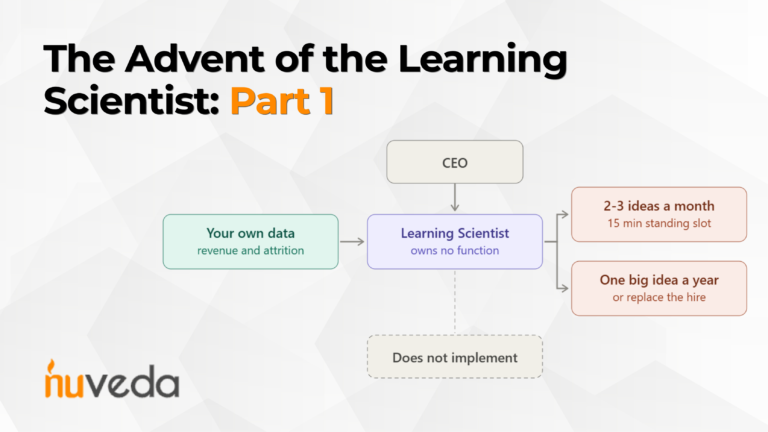
So what does the CEO actually receive for the money? My answer is deliberately concrete: two or three interesting ideas a month, put in front of the leadership team to evaluate and mull over. Please note that I am not asking for thirty finished studies a year or a dashboard. Two or three propositions of the kind above which are grounded in the organization’s own data, each one worth an hour of the leadership team’s argument.
Most of these propositions will go nowhere. A few will change where the company spends its time and resources. That ratio is the typical nature of research, and a leadership team that cannot tolerate it should not create the position.
And some of those ideas will make some leaders defensive, because the data will occasionally point at their function. That is the entire purpose for the role of the learning scientist. The role exists so that the data can say something no one in the room is incentivized to say. The monthly rhythm is the cadence for the ideas while the actual measurement is annual.
Within twelve months, the Learning Scientist has to produce one big idea the entire organization can rally around. Not a portfolio of incremental improvements but a single proposition substantial enough that people across functions can discuss and argue about it, and potentially change what they are doing because of it.
That is what separates this role from a well-informed analyst, and it is the standard I would hold it to at the first annual review. The thirty-odd ideas surfaced along the way are the means to the end product. A CEO evaluating this investment should be relaxed about the monthly idea turnover but focus on the annual big idea.
I will add one caveat, since I have just handed you a way to grade the role. A big annual target creates its own pressure toward the idea that is easy to rally around rather than the one that is right for the business. Watch for a Learning Scientist whose big idea flatters everybody. The best ones must be uncomfortable for at least one person in the room, and that could quite possibly be you.
The mandate
Stop hiring for training. Start hiring for learning science. Concretely, the mandate covers four things:
- Explore the unmapped — and treat the absence of data as evidence. I have put this first deliberately, because it is the least obvious and the most valuable. Most enterprises can tell you the completion rate of every course they have ever run. Very few can tell you which capability they have never once attempted to measure. Test this on your own organization: pick the capability your strategy depends on most over the next three years, and ask what data you hold on it. If the answer is nothing, that silence is a finding. Gaps in your data map to parts of your business nobody is examining, and those are frequently where the opportunity is.
- Use data to identify trends and direct investment. Including sensitive data — revenue, cost reduction, attrition. This is a real prerequisite, not a footnote: a Learning Scientist who is denied access to commercial data is just a glorified reporting analyst. Give them access or do not create the role.
- Identify where capability is a competitive strength or weakness. Not benchmarked against a generic industry standard, but against what your specific strategy requires you to be good at.
- Upgrade talent for efficiency and efficacy. With interventions chosen because the data pointed at them, not because they were on the annual calendar.
What the Learning Scientist should not do
Here I want to be as firm as I have been about the mandate, because this is where the role will be destroyed if it is not protected.
The Learning Scientist should not implement.
They should not own program rollout, vendor management, the LMS, the annual calendar, or compliance completion. Every one of those is real work that somebody has to do, and every one of them is infinitely more urgent than the analysis that only pays off in two quarters. If you hand over this work to the Learning Scientist, you can be sure that they will no longer be performing that role for you.
I liken it to the way physics splits the labor. The theorist’s job is to propose something worth testing. That work needs room, and it needs tolerance for the fact that most of what they propose will not survive contact with the experimental data. If you evaluate them on delivery volume, they will stop proposing anything risky, and you will have paid a premium for a reporting analyst.
The bigger mistake, and the easier one to make: the Learning Scientist is not a Chief Learning Officer.
A CLO is an executive who owns a function such as a budget, headcount, delivery, a seat in the operating rhythm, and an answer when the board asks how the L&D budget performed. That is a demanding leadership job and organizations need it. It is a radically different job. The Learning Scientist owns no function at all. However, the Learning Scientist will know how to influence senior leaders to get to the data and understand the business of the company’s leaders. That requires real political acumen and the gravitas to engage in business discussions with the company’s leaders.
The Learning Scientist has to be free to conclude that a flagship program is not working and to say so without it being a verdict on their own record. If you put both mandates in one person, the awkward findings will quietly stop appearing. The CLO is measured on the performance of the function they run, which means they are structurally invested in the programs already in flight. That is why they need to have different roles: the CLO and the Learning Scientist.
This settles the reporting line for me as well: the Learning Scientist reports to the CEO and not to the CLO or the CHRO. In effect, the CEO says that learning is a competitive advantage for the company, and that he or she wants direct access to that learning.
I know how that sounds: yet another role claiming a line to the top. But if you follow the logic of the previous paragraph, you will understand the necessity of this structure. If the findings are going to make function heads uncomfortable, then routing the role through any of those functions gives someone both the motive and the authority to soften a finding before it reaches the people who could act on it. It will be enough that a finding gets reframed as “early” or “needing more work” for a couple of quarters running. Reporting to the CEO is the only structure in which the awkward idea will survive the journey to the table.
Note to the CEO: If your Learning Scientist’s calendar looks like an Operational Leader’s calendar, the role has already collapsed.
I will add a caveat because reporting to the CEO carries its own failure mode. The CEO’s calendar is the scarcest resource in the building. A role that depends on the CEO finding a spare hour will go a quarter without a hearing, and then two or three ideas a month quietly becomes two or three a quarter. So my suggestion is to not leave it to goodwill. Give the Learning Scientist a standing slot in a forum that already meets such as the monthly leadership review, the operating committee, whatever has a decision-making rhythm in your organization. Fifteen minutes, every month, on the agenda by default rather than by request. Reporting to the CEO provides the independence for the Learning Scientist while the various forums provide the operational rhythm of accountability.
There is a fair objection to all of this, and leaders should press on it: a researcher completely insulated from execution drifts into irrelevance and gets cut in the next budget cycle. I don’t have a clean answer to this, and I want to be straight about why it’s hard. The findings will span sales, operations, product, pricing. While a CEO will want to tie it to outcomes, no single function’s feedback loop fits. The open problem is which function owns the actionable steps, and not what the Learning Scientist proposed or questioned in the first place.
There is always the objection of a quantifiable number for businesses. I think physics has already solved this one. A theorist has no number either. There is no saving attached to a proposition, and there never has been. What the field measures instead is whether the proposition could be tested and applied in a way humanity could use. In a company’s parlance: was the idea actionable, did anyone act on it, and did the organization change or benefit because of it. That is adoption in place of citation, and it is the standard I would hold a Learning Scientist to at twelve months. I don’t have a savings number for you. Physics did not have one either, and we can all agree that it has done remarkably well for all of us.
As a CEO, I would still demand once every twelve months a big idea substantial enough that the company changes what it does because of it and not one that everybody likes. If that scientist does not fit the bill, it would be time to hire another scientist.
Isn’t this just a Six Sigma Black Belt?
I spent the nineties as a Certified Master Black Belt at GE. Six Sigma taught a generation of companies to perfect what they were already doing and design for success. It was never designed to tell you what to do with all the data or wrestle with the absence of data. That gap is now the most expensive one in most enterprises.
Some of you will have recognized the shape of this already, and you are right to. Jack Welch’s Black Belts were pulled out of line responsibility, trained through a structured program and sponsored from the very top. GE could not find those people in the market either, so it used the Crotonville Academy and trained them. This is not a new organizational idea, and I am borrowing it deliberately.
The difference is what the two roles point at. Six Sigma starts with a process you already run and a defect you already count, and then reduces the variance. It is valuable, but it cannot see the capability you have never measured. Why? Because there is no process there to improve. 3M found this out the hard way when Six Sigma was pushed into R&D and innovation output fell. My first mandate point is the exact inverse of DMAIC.
DFSS (Design for Six Sigma) is a methodology to design processes which are Six Sigma compliant to begin with, but it still does not address the issues a Learning Scientist must.
To simplify, the Learning Scientist is there to ask whether it is still the right thing to do, and to ask what you have never measured at all.
I will concede one point to the Black Belts. Every one of them had a number attached to their name, which was the savings from the project they ran. That is a large part of why the role survived budget scrutiny for over a decade. My Learning Scientist has no such number, for the reasons I have just described. I would rather say so than dress it up.
If you cannot hire one yet
The most common objection I hear about all of this is a practical one: this person is hard to find. That is a fair objection. The profile sits at the intersection of data, behavioral insight and a commercial business acumen. There are very few people who are trained for this, and if anything, they are probably CEOs to begin with.
Your best candidate is probably already on the payroll, and probably not in L&D. You may wish to look in analytics, in strategy, in corporate development, maybe even in product leadership. You are looking for someone who is already comfortable with messy data and already trusted in a leadership discussion.
You do not have to build the capability alone. A university partnership is a serious route to creating this capability inside your organization.
Universities already hold the half of this role that is hardest to acquire commercially: research design, statistical rigor, and hypothesis testing. You must structure it so that they never hold your data or your business context. For example, a faculty member can be seconded into the organization for a defined period, no less than twelve months. A program can be co-designed to train someone you already employ. You may wish to allow doctoral research to be conducted on anonymized company data, with the organization getting the findings and the university getting the publication.
However, this route does not replace your need for a learning scientist and be clear about the trade-offs. I would treat the university route as a way to train your Learning Scientist, but not as a way to outsource the job. The person still must be yours. They still must report to you and sit in your operational forums. They also must be able to contribute meaningfully in leadership discussions.
This would appear to be the fastest way to get this effort off the ground, especially for those enterprises who are keen on experimenting with this idea.
Where this goes
The measurement discipline for this already exists: Kirkpatrick’s levels one through four have been around for decades. What has been missing is anyone senior enough, and close enough to the commercial data, to run the analysis at level four and take the answer to the board.
I can give you one honest data point on how rare that is. Across the 50-plus enterprise clients we support, in my estimate fewer than one in ten arrives with any level four measurement already in place. The overwhelming majority, most of them sophisticated, well-run organizations are spending on capability without a mechanism to connect it to a business result. This is because there is no one actively looking for such connections.
At NuVeda we call the destination the Google of Learning: a world where capability is measured, verified and portable, rather than asserted. The Learning Scientist is the person who gets an organization there.
In Part 2, I will get practical: who to hire for this role, what background actually predicts success in it, how to protect the two-or-three-ideas-a-month rhythm once the organization starts pulling the role toward delivery, and what a sensible first ninety days looks like. If you are running an organization and this argument lands, I would like to hear what you would set your Learning Scientist loose on first.