
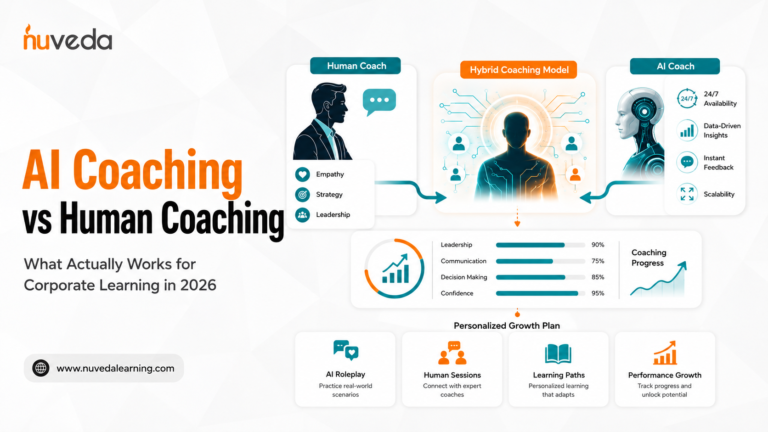
AI Coaching vs Human Coaching: What Actually Works for Corporate Learning in 2026
If your organisation has a training budget, you are likely wrestling with a critical question this year: do we replace our traditional coaching spend with AI, augment it, or ignore the trend entirely?
Ignoring the shift is no longer an option. The AI-driven career coaching market is surging from $5.48 billion in 2025 to $6.69 billion in 2026—a massive 22.3% annual growth rate. With corporate adoption up 156% year-over-year and 62% of Fortune 500 companies actively integrating AI coaching, the landscape has officially changed.
But hype and growth statistics do not answer the most practical question for L&D leaders: What actually drives better performance, deeper skill development, and measurable behaviour change? Is it AI coaching, human coaching, or a blend of both?
This guide cuts through the noise to give you an honest answer grounded in 2026 evidence. We break down what each model does best, where they fall short, the real-world outcomes, and how forward-thinking organisations are combining both to scale their learning programmes without sacrificing quality.
1. What Is AI Coaching? Clearing Up the Confusion
"AI coaching" is one of the most overloaded terms in learning technology in 2026. It currently covers a wide spectrum of very different things:
- Chatbot-based coaching: an AI assistant that answers questions, provides encouragement, and delivers structured reflection prompts. Useful for goal-tracking and habit reinforcement. Not the same as skill development coaching.
- AI-powered coach matching and administration: platforms that use AI to match coachees with human coaches, schedule sessions, analyse outcomes, and automate reporting. AI as infrastructure, not as the coach itself.
- AI-driven personalised learning recommendations: an AI-powered learning platform that uses behavioural data to recommend the next learning resource, skill module, or development activity. Coaching-adjacent, not coaching itself.
- AI roleplay and simulation: an AI persona that participates in a structured practice conversation with a learner, responding dynamically to what they say, providing real-time feedback, and scoring performance across specific competencies. This is the category that is growing fastest and producing the most compelling evidence for behaviour change.
- AI-augmented human coaching: human coaches using AI tools to analyse session transcripts, generate progress summaries, track coachee development data across multiple sessions, and identify patterns that inform their coaching approach.
When people ask "does AI coaching work," they are often asking about fundamentally different things. The answer depends heavily on which of these categories you are evaluating, and what outcome you are trying to produce.
2. What Is Human Coaching? The Baseline
Human coaching in a corporate context is a structured developmental relationship between a trained coach and an individual, focused on improving performance, building capability, and achieving specific professional goals.
The executive coaching and leadership development market is estimated at $112.98 billion in 2026, up from $103.56 billion in 2025, growing at a 9.11% CAGR and projected to reach $174.53 billion by 2031.
Human coaching takes several forms in organisations:
- Executive coaching: typically for VP-level and above, delivered by an external ICF-accredited coach, focusing on leadership effectiveness, strategic thinking, and senior-level challenges. Typically 6–12 sessions over 4–6 months. Cost: $3,000–$15,000+ per person.
- Manager coaching: targeted at people managers, often delivered by internal HR business partners or external coaches. Focuses on team leadership, feedback delivery, performance conversations, and people development capabilities.
- Peer coaching and coaching circles: structured peer-to-peer coaching programmes where managers coach each other using a defined methodology. Lower cost but requires significant facilitation and quality assurance infrastructure.
- Coach-facilitated group development: cohort-based programmes where a coach works with a group of managers on shared leadership challenges, using case discussions, peer feedback, and reflection exercises.
The common denominator: a human coach brings empathy, contextual judgment, genuine relationship, and the ability to navigate complexity and ambiguity in ways that AI cannot, yet.
3. The Scale and Cost Problem That Started This Debate
The fundamental tension driving the AI coaching debate is not philosophical. It is economic.
If every manager in your organisation could have access to a skilled human coach, the debate would not exist. The problem is that they cannot, at least not at any cost structure that is sustainable at scale.
Consider the arithmetic for a mid-size organisation with 500 people managers:
- Executive-level external coaching (VP+, top 50 managers): at $5,000 per person, that is $250,000 per year
- Mid-level manager coaching (next 200 managers): at $2,000 per person, that is $400,000 per year
- Front-line manager development (remaining 250): no budget remaining, they get a workshop, a self-paced e-learning module, and a completion certificate
The result is a two-tier development system: rich, personalised support for senior leaders and essentially nothing beyond generic training for the largest and most critical tier of management in the organisation. The managers who have the most direct daily impact on employee experience and retention get the least developmental investment.
This is the problem AI coaching is actually solving, not replacing senior executive coaching, but extending meaningful, personalised development to the management population that the budget has never been able to reach.
4. Where AI Coaching Wins
Based on 2026 evidence and the maturity of current platforms, AI coaching has clear, substantive advantages in the following areas:
AI coaching scales to every employee in the organisation at once, without the cost per head that makes human coaching inaccessible to most of the workforce. AI coaching costs approximately 80% less than traditional executive coaching, making meaningful personalised development accessible to manager populations that would never have justified the spend for human coaching.
Human coaches have calendars. AI does not. A manager who wants to practise a difficult feedback conversation at 10pm before a challenging team meeting the next morning can do so with an AI coaching platform. This availability closes the gap between learning and application that is one of the primary reasons training does not change behaviour, people learn skills in a training session and then cannot practise them before needing them in a real situation.
AI roleplay platforms are more immersive and feel more real than standard e-learning, increasing knowledge retention and behaviour change, while enabling on-demand practice with less dependency on scheduling large groups.
One of the most significant advantages of AI coaching for skill development is that learners can make mistakes, receive feedback, and try again without social consequences. A manager practising a performance improvement conversation with an AI persona who plays a defensive, emotional team member can explore difficult dynamics without the risk of damaging a real relationship. This psychological safety enables a level of authentic practice that most human coaching programmes struggle to create.
Traditional L&D functions rarely have access to meaningful behavioural data, tracking attendance, completion rates, and satisfaction surveys, indicators that say little about real-world performance. AI coaching systems generate rich, granular analytics that reveal how employees actually communicate and how their skills evolve over time.
An AI coaching platform can score every conversation across multiple competency dimensions simultaneously, clarity, empathy, questioning technique, listening, influence, and track how those scores change over multiple practice sessions. This is data that no human coaching programme generates at scale, and it is exactly the kind of evidence that HR leaders need to demonstrate coaching ROI to their CFO.
Human coaches give feedback in sessions. AI coaching platforms give feedback immediately, during or within seconds of a practice conversation. The cognitive science of learning consistently shows that immediate feedback is more effective at changing behaviour than delayed feedback, because it is delivered while the memory of the specific action is still active.
Human coaching quality varies significantly between coaches, between sessions, and across different cultural and regional contexts. AI coaching delivers a consistent standard of practice environment, feedback calibration, and scenario quality regardless of geography, time zone, or availability.
5. Where Human Coaching Still Wins
Despite the genuine advantages of AI coaching, there are categories of development where human coaches remain substantially superior, and where organisations should be cautious about substituting AI.
Leadership development at senior levels often involves deeply personal work: confronting fixed mindsets, processing difficult career experiences, navigating identity-level challenges around authority and vulnerability. This work requires genuine human empathy, skilled reading of emotional states, and the trust of an authentic relationship. Human coaches provide strategic depth, challenge, and relational safety, while AI reinforces application and tracks progress continuously. No AI can fully replicate the experience of a skilled coach sitting with someone in a moment of professional vulnerability and helping them make sense of it.
When a senior leader is working through a challenge that involves specific relationships, organisational culture, board dynamics, or politically sensitive people situations, the contextual judgment required goes far beyond what AI can currently model. Human coaches can hold the complexity of real organisational life in ways that AI coaching scenarios, which necessarily simplify context, cannot.
Some of the most valuable coaching conversations are not about practising a specific skill or working toward a defined outcome. They are open-ended explorations, "I'm not sure what I want from my next career move" or "I feel like my leadership style isn't working and I don't know why." This kind of inquiry requires a human coach who can sit comfortably with ambiguity, follow unexpected threads, and resist the temptation to direct the conversation toward a predetermined framework.
For the most senior leaders in an organisation, CEOs, C-suite executives, board members, the quality of coaching input, the judgement of the coach, and the depth of the relationship remain more important than the scalability of the intervention. The best fit for human-only coaching remains senior leadership cohorts (VP and above), high-potential employees with complex development needs, and organisations with dedicated executive development budgets.
AI coaching platforms are improving rapidly in their ability to handle cultural context and interpersonal nuance, but human coaches who share cultural background, industry experience, or relevant professional history with their coachees can navigate these dimensions more authentically than any AI system available in 2026.
6. What the Evidence Actually Shows
Setting aside vendor claims and marketing statistics, what does the peer-reviewed and independent research evidence actually show about AI coaching effectiveness in 2026?
AI roleplay achieves 80–90% completion rates versus 15–20% for traditional e-learning. Learners report becoming 275% more confident through immersive simulation-based training. Organisations report 300–500% ROI in the first year of deployment.
AI-powered conversational simulations can lead to a 30% improvement in employee soft skills training effectiveness. 60% of organisations implementing AI-driven training solutions report increased employee engagement.
Enterprise B2B teams using AI in sales coaching programmes are 20% more likely to improve their revenue results than those that do not. 43% of revenue enablement leaders now use AI-powered roleplay to enhance sales coaching, up from near zero three years ago.
A 2025 study by Passmore, Tee, and Rutschmann evaluated an AI coaching agent against the ICF competency framework with 43 managers participating in AI-led workplace sessions. The study found that AI coaching produced measurable improvements in goal clarity, self-awareness, and action commitment, outcomes previously associated primarily with human coaching, when delivered through a structured, competency-aligned protocol.
The evidence for human coaching effectiveness is robust and long-standing. Multiple meta-analyses confirm that professional coaching produces significant improvements in self-awareness, goal attainment, well-being, and leadership effectiveness. A mid-market organisation following a data-driven coaching platform implementation process reported a 25% reduction in leadership churn before rolling out organisation-wide.
The honest conclusion: The evidence is not "AI beats human coaching" or "human coaching beats AI." The evidence shows:
- AI coaching is significantly more effective than no coaching for skill practice and behavioural development at scale
- AI roleplay produces substantially higher engagement and practice volume than traditional e-learning and workshop training
- Human coaching produces deeper transformation at the individual level, particularly for senior leaders with complex development needs
- The combination of both produces better outcomes than either alone
7. AI Coaching vs Human Coaching: Side-by-Side Comparison
| Dimension | Human Coaching | AI Coaching | Hybrid |
|---|---|---|---|
| Cost per person | $2,000–$15,000+ | $50–$300 | $500–$2,000 |
| Scale | Limited by coach availability | Unlimited | High |
| Availability | Scheduled sessions | 24/7 on-demand | Both |
| Personalisation | Very high (relationship-based) | High (data-driven) | Very high |
| Emotional depth | Very high | Low-medium | High |
| Skill practice volume | Low (limited session time) | Very high (unlimited reps) | Very high |
| Behavioural data | Very low | Very high | Very high |
| ROI visibility | Low | High | High |
| Complexity handling | Very high | Medium (improving) | Very high |
| Consistency | Variable | Consistent | High |
| Cultural nuance | High (with right coach) | Medium | High |
| Best for | Senior leaders, complex needs | Manager populations at scale | All levels |
8. The Hybrid Model: Why the Best Answer Is Both
The most important finding from 2026 evidence is not that AI is replacing human coaching. It is that the organisations producing the best development outcomes are using AI and human coaching together, intelligently divided by what each does best.
75% of high-performing coaching businesses now regularly use AI co-pilots. 45% of coaches report that AI significantly augments their practice rather than replacing it.
The most effective model in 2026 looks like this:
- Tier 1, Senior leaders (top 10–20% of management population): Human executive coaching + AI tools to supplement between sessions, track progress, and generate session data. Full relational depth and complexity handling at the level where it matters most.
- Tier 2, Middle managers (the largest management population): AI coaching platforms for regular skill practice and behavioural development + periodic group coaching with a human facilitator + 360-degree feedback to identify development priorities. Affordable, scalable, and measurable.
- Tier 3, Emerging talent and frontline managers: AI roleplay and simulation for core skill practice + learning management system delivery of structured development content + peer coaching circles. High volume, low cost per head, measurable behavioural outcomes.
Leadership coaching produces the highest ROI when it becomes a daily habit, not a weekly event. AI bridges the gap between sessions by delivering personalised practice scenarios, micro-learning nudges, and reflection prompts that keep behavioural development in motion between formal sessions.
This is not compromise. It is intelligent design. AI handles what AI does well, scale, consistency, data, and practice volume. Human coaches handle what humans do well, depth, empathy, complexity, and the transformational relational work that only a real human relationship can enable.
9. AI Roleplay and Simulation: The Game-Changer for Skill Practice
Of all the AI coaching modalities available in 2026, AI roleplay and contextual simulation is producing the most compelling and consistent evidence for real behaviour change, and the fastest adoption rates.
AI roleplay lets employees practise real conversations, a sales pitch, a difficult customer interaction, a compliance scenario, a performance review, with an AI persona that responds naturally, adapts dynamically, and provides immediate feedback.
The fundamental problem with most corporate training is not the quality of the content, it is the absence of practice. A manager can watch a video about how to handle a defensive team member in a performance conversation. They can read a guide. They can attend a workshop where a trainer role-models the technique. None of this creates competence. Competence requires practice, realistic, repeated, feedback-rich practice of the actual conversation, not a description of it.
Human roleplay in training programmes provides some of this, but it is severely limited by time, observer embarrassment, facilitator availability, and the inability to reset and try again without social awkwardness. AI roleplay removes every one of these constraints.
AI roleplay platforms enable on-demand practice, with less dependency on scheduling large groups, automated feedback that frees trainers from basic practice facilitation, and the ability to tailor scenarios to specific industries, regions, languages, and roles.
- Sales and revenue enablement: practising pitch delivery, objection handling, negotiation, and closing conversations. The data here is particularly strong: enterprise B2B teams using AI in sales coaching programmes are 20% more likely to improve revenue results.
- Healthcare: practising patient communication, clinical disclosure conversations, and multi-disciplinary team interactions in a safe environment where errors have no consequences.
- Financial services and insurance compliance: practising regulatory disclosure, compliant sales conversations, and difficult client situations where exact language matters.
- Retail and customer service: practising difficult customer interactions, de-escalation, complaint handling, and upselling in realistic scenarios before hitting the shop floor.
- Leadership and management: practising feedback delivery, performance conversations, change communication, and conflict resolution with AI personas that respond with realistic emotional complexity.
10. How to Evaluate an AI Coaching Platform
With a fast-growing and uneven market, evaluating AI coaching platforms requires rigour. Here is what to look for beyond the demo.
Ask to participate in a demo scenario yourself, as the learner, not as an observer. The AI persona should respond dynamically to what you say, handle unexpected tangents without breaking character, and generate feedback that is specific to your individual responses rather than generic to the scenario. If the AI response feels scripted or predictable after three exchanges, it will not sustain learner engagement through a full programme.
Generic scenarios produce generic skill development. Look for platforms that can build scenarios tailored to your specific industry, role level, cultural context, and the actual situations your people face. A pharma field representative practising a clinical evidence conversation needs a fundamentally different scenario from a retail manager practising a performance review.
The value of AI roleplay is entirely dependent on the quality of the feedback. Feedback should be immediate, competency-specific, and actionable, not "good effort, try to be more empathetic next time." Ask to see sample feedback reports from real learner sessions before committing.
An AI coaching platform that exists as a standalone tool produces isolated practice data that never connects to the rest of your learning and performance infrastructure. Look for platforms that integrate with your enterprise LMS, your 360-degree feedback tools, and your HRMS, so that practice data informs development planning and Kirkpatrick Level 3 measurement is possible.
The platform must generate meaningful, exportable data on skill development over time, not just completion records. Ask specifically: "What does a report look like for a cohort of 50 managers after 90 days of using the platform?" If the answer is a completion dashboard, the platform is not measuring what matters.
The ICF has introduced AI coaching standards focused on transparency, data governance, and the preservation of the human coaching relationship. The 2024 ICF guidelines state explicitly that AI tools in coaching must be deployed with informed client consent, with clear disclosure of how client data is used and stored. Verify GDPR compliance, data residency, and consent processes before deployment.
11. How NuCoach.ai Fits Into the Enterprise Learning Ecosystem
NuCoach.ai is NuVeda Learning's AI coaching and simulation platform, currently in Beta, built specifically for enterprise learning ecosystems that need to extend meaningful skill practice and development to large management populations that traditional coaching budgets cannot reach.
What makes NuCoach.ai different from standalone AI coaching tools
Most AI coaching platforms are standalone tools. They provide a practice environment, but that environment sits outside your organisation's learning infrastructure, disconnected from your training content, your 360 feedback data, and your performance outcomes.
NuCoach.ai is designed to operate as the third stage of a connected learning ecosystem:
- Stage 1, Assess: Nu360 identifies the specific skill and behaviour gaps that need to be addressed, with multi-rater evidence from managers, peers, and direct reports.
- Stage 2, Learn: CALF™ delivers structured, personalised learning content aligned to those gaps, with spaced repetition, Learning Action Plans, and built-in Kirkpatrick Level 3 and Level 4 measurement.
- Stage 3, Grow: NuCoach.ai provides contextual AI roleplay and simulation that lets learners practise the specific behaviours they are developing, in scenarios aligned to their industry, role, and real job context, with immediate, competency-specific feedback and behavioural tracking over time.
This is the Assess → Learn → Grow model that NuVeda's product suite operationalises end to end. No other platform in the market connects all three stages, 360 feedback, LMS delivery, and AI coaching practice, in a single integrated system.
Job-role-aligned simulation: the core design principle
The most important design choice in NuCoach.ai is that every simulation is built around real job roles in real industry contexts, not generic leadership scenarios.
A pharma medical representative practises a clinical evidence conversation with a sceptical GP. A retail store manager practises a performance improvement conversation with a defensive team member. An insurance compliance officer practises a regulatory disclosure conversation with an impatient client. A healthcare clinical trainer practises an onboarding conversation with a new nursing cohort.
This job-role alignment is what produces genuine behaviour change, because the practice mirrors the real situation closely enough that the skills built in the simulation transfer to the actual performance context.
NuCoach.ai and the Kirkpatrick model
Because NuCoach.ai operates inside the CALF™ ecosystem, its practice data contributes directly to Kirkpatrick Level 3 measurement: evidence that learning has changed on-the-job behaviour. The progression from completing a learning module (Level 2) to demonstrating improved competency scores across repeated AI roleplay sessions (Level 3), and then to measurable improvement in business outcomes like sales conversion, compliance incident rates, or customer satisfaction scores (Level 4), is trackable within a single connected platform.
This is the evidence chain that L&D leaders need to make the case for learning investment to their CFO and board, and it is precisely what standalone coaching tools and generic LMS platforms cannot provide.
12. Frequently Asked Questions
Yes, with important caveats about what you mean by "AI coaching" and what outcome you are trying to produce. AI roleplay and simulation platforms consistently show 30% improvements in soft skills effectiveness and significantly higher completion and engagement rates than traditional e-learning. AI coaching is not a replacement for human coaching in high-complexity or senior leadership contexts, but it is significantly more effective than no coaching at all for the majority of the management population who have historically received no personalised development support.
Neither is universally better. They are better at different things. Human coaching excels at depth, empathy, complexity, and transformational individual development. AI coaching excels at scale, cost, data, availability, and practice volume. The organisations producing the strongest outcomes in 2026 are using both, human coaches for senior leaders and complex needs, AI coaching for the broader management population.
AI roleplay training is a learning modality in which an employee practises a real-world conversation, a sales pitch, a performance review, a compliance disclosure, a patient interaction, with an AI persona that responds dynamically to what they say, adapts to unexpected directions, and provides immediate, competency-specific feedback. It enables unlimited, on-demand practice without social risk, scheduling constraints, or per-session cost.
Human executive coaching typically costs $3,000–$15,000 per person per engagement. AI coaching platforms typically cost $50–$300 per person per year, approximately 80% less than traditional coaching. This cost structure makes meaningful personalised development accessible to management populations that have never justified the spend for human coaching.
The International Coaching Federation (ICF) has published ethical guidelines for AI in coaching (2024), requiring informed client consent, clear disclosure of data usage, and preservation of the human coaching relationship where appropriate. ICF-compliant AI coaching platforms disclose their AI nature to users, explain how conversation data is stored and used, and do not position AI as a replacement for accredited human coaches in complex development contexts.
The most effective AI coaching implementations are integrated with the organisation's learning management system, so that practice data from AI coaching sessions informs personalised learning recommendations, contributes to Kirkpatrick Level 3 measurement, and connects to the organisation's broader performance and talent management data. Standalone AI coaching tools that operate outside the LMS produce isolated data that is difficult to connect to business outcomes.
Sales, financial services, healthcare, pharmaceuticals, retail, and leadership development consistently show the strongest results from AI roleplay, because these industries require employees to master specific, high-stakes conversations that are difficult to practise safely in real settings. Any context where the skill involves a structured interaction with another person is a strong candidate for AI roleplay practice.
The Bottom Line
The AI coaching vs human coaching debate is the wrong frame.
The right question is: how do we design a development system that gives every manager and employee access to the quality of support they need to actually improve, at a cost and scale that is sustainable?
The answer in 2026 is a connected, three-stage system: assess gaps with multi-rater feedback, deliver personalised learning through an AI-powered learning platform, and build real capability through AI roleplay and simulation practice. Human coaches remain essential at the senior levels where depth and relationship matter most. AI handles the practice, the data, the consistency, and the scale that makes development accessible to every level of the organisation.
The organisations building this model are not choosing between AI and human. They are choosing both, and producing development outcomes that neither approach achieves alone.
Ready to see what AI-powered practice and simulation looks like for your organisation? Book a free demo and explore NuCoach.ai, plus the full NuVeda learning ecosystem.