
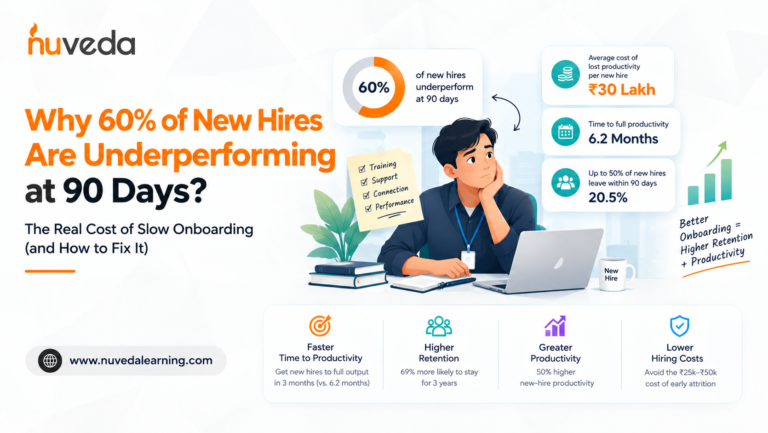
Why 60% of New Hires Are Underperforming at 90 Days?
Most L&D and HR leaders cannot answer that question without opening a spreadsheet, making three phone calls, and spending a week they do not have.
The audit notice arrived. The date is confirmed. And somewhere between your HRMS, your training platform, your physical files, and a shared drive folder nobody has touched since 2024, lies the evidence you need to demonstrate that every employee in a regulated role completed the training they were supposed to complete, when they were supposed to complete it.
Indian companies continue to face regulatory action because existing audit mechanisms fail to independently assess compliance with the full spectrum of legal obligations. With 13,000 regulatory changes every year, an organisation conducting only annual compliance reviews could accumulate 90 to 270 days of undetected compliance exposure between audit cycles.
The training certification gap is one of the most common, and most avoidable, forms of that exposure. And in 2026, it is getting harder to hide. Heightened regulatory scrutiny, evolving safety and quality standards, and persistent workforce turnover are forcing leaders to re-evaluate whether their LMS can truly support modern compliance demands, or whether it is quietly holding them back.
This guide is for the L&D or HR leader who has six weeks, a regulatory inspection on the horizon, and a training system that was not built to answer hard questions quickly. It covers what auditors actually look for, where certification gaps typically hide, what to do in the next six weeks, and how to build a system that makes this question answerable in minutes, not days.
Table of Contents
- 1. What Auditors Are Actually Looking For, And Why Completion Records Are Not Enough
- 2. Where Certification Gaps Hide in Most Organisations
- 3. The 6-Week Pre-Audit Action Plan
- 4. The Industries Where This Risk Is Highest
- 5. Why Most LMS Platforms Cannot Answer the Audit Question
- 6. What a Compliance-Ready Training System Actually Looks Like
- 7. How CALF™ and Nu360 Close the Certification Gap
- 8. Frequently Asked Questions
- 9. The Bottom Line
1. What Auditors Are Actually Looking For, And Why Completion Records Are Not Enough
The first mistake organisations make when preparing for a compliance audit is treating training certification as a documentation problem. It is not. It is a competence problem, and auditors in 2026 are increasingly equipped to tell the difference.
A completion record proves that an employee sat through a training module. It does not prove that they understood it, that they can apply it, or that their behaviour on the job reflects what they were trained to do.
Regulators across IRDAI, SEBI, RBI, CDSCO (pharma), and clinical accreditation bodies are asking increasingly specific questions:
- Not just "was the employee trained?" but "when were they trained, and has that certification been renewed if it has expired?"
- Not just "what was the pass mark?" but "what was the assessment design, and does it test application of the requirement, not just recall of the text?"
- Not just "do you have a record?" but "can you produce a complete audit trail for this employee's training history, including every assessment attempt and score, without any gaps?"
LMS functionality gaps lead to cascading consequences. Many organisations give the impression that they have failed to deploy and maintain a compliant quality initiative, not because they did not train their people, but because their training records cannot be presented defensibly during an audit.
The three questions every auditor asks
"Show me the certification status of every employee in this role, as of today." Can your current system generate this report in under five minutes, not as a manually assembled spreadsheet, but as a live dashboard pulling from a single source of truth?
"When does this certification expire, and what happens when it does?" Does your system automatically flag approaching expiry, trigger re-enrolment, and prevent a lapsed employee from continuing in a certified role, or does someone have to remember to check?
"What evidence do you have that training changed how this employee works?" This is the Level 3 Kirkpatrick question. For some regulatory frameworks, completion evidence is sufficient. For others, particularly in clinical, GxP, and financial advice contexts, evidence of behavioural competence is what separates a satisfactory audit finding from a critical one.
2. Where Certification Gaps Hide in Most Organisations
Most organisations do not have a training problem. They have a visibility problem. The training happened. The record of it is somewhere. The system cannot surface it quickly enough to be useful when it matters most.
Here is where certification gaps consistently appear:
New joiners who fell through the onboarding gap
High attrition industries, retail, BFSI field sales, healthcare support staff, have a constant flow of new employees. Every new joiner needs to be enrolled in their mandatory certification programme from day one. When new joiner data flows from HRMS to training system manually, or on a weekly batch, employees can be working in certified roles for days or weeks before their training assignment has even been created. That gap is invisible until an auditor asks for the enrolment date alongside the completion date.
Role changes without training reassignment
When an employee moves from a general role to a certified role, a bank teller becoming a relationship manager, a pharmaceutical sales executive moving into a compliance-sensitive product line, a healthcare administrator taking on a clinical coordination responsibility, their training requirements change. If the training system is not connected to the HRMS, the role change updates the HR record but leaves the training profile unchanged. The employee is performing a certified role with the certification profile of their previous one.
Certifications that expired quietly
In 2026, audits are uncovering reporting and traceability gaps around manual certification tracking, particularly certification expiry, as one of the most common findings in regulated industries. A certification issued 18 months ago may have an annual renewal requirement. If the system does not flag expiry, send the renewal prompt, and track re-completion, the expiry happens silently. The employee continues working. The gap accumulates. The auditor finds it.
Leavers whose records are incomplete
When an employee leaves, their training records need to be retained, typically for three to seven years depending on the regulatory framework. In many organisations, leaver records are locked, archived inconsistently, or simply inaccessible in the production system. An auditor asking for the training history of someone who left 18 months ago should receive a complete, timestamped record. What they often receive instead is an acknowledgement that the data "should be somewhere."
Third-party contractors and temporary staff
Compliance risks show stark variability across business units, manufacturing units achieve a 79% compliance rate, while other units lag significantly. Contract and temporary workers are often the lagging segment. They are in certified roles, subject to the same regulatory requirements, but frequently excluded from the main training system, managed through a separate process, or not managed at all.
3. The 6-Week Pre-Audit Action Plan
You cannot build a perfect compliance training system in six weeks. You can, however, take the steps that turn a chaotic evidence-gathering exercise into a defensible, structured audit response. Here is the sequence that matters.
Week 1: Get a complete current-state picture
Pull every data source that contains training records, your LMS, your HRMS, your manual spreadsheets, your paper files. For every employee in a regulated role, document:
- What certifications their role requires
- Which of those certifications are currently recorded as complete
- The completion date and the expiry date (if applicable) of each
- Any gaps: certifications required but not recorded as complete
Do not try to fix gaps in Week 1. Map them. The map is what tells you where to focus and what evidence you will need to produce or explain.
Week 2: Triage by risk level
Not all gaps are equally dangerous. Prioritise by:
Highest risk: active gap in a currently employed, regulated-role employee. This person is working in a certified role with a missing or expired certification today. This is the auditor's highest-priority finding. Every gap in this category needs to be either closed (enrol and complete immediately) or explained with documented mitigating action.
Medium risk: expired certification with no renewal in progress. The original certification exists. The renewal is overdue. Action: initiate renewal immediately and document the date of initiation.
Lower risk: historical records that are incomplete or inconsistently formatted. The training happened but the record is not audit-ready. Action: locate the source evidence, standardise the record format, and ensure it is accessible from a single location.
Week 3: Close the highest-risk gaps
For active gaps in currently regulated employees: launch mandatory completion campaigns with explicit deadlines, manager accountability, and daily tracking. Brief line managers personally, not by email. Make clear that this is not a training hygiene exercise; it is a regulatory requirement with a hard deadline.
For every gap you cannot close before the audit date: prepare a written explanation of when the training occurred, why the record is incomplete, and what corrective action has been taken. An auditor who receives an honest, structured explanation with evidence of corrective action responds very differently from one who receives a denial or silence.
Week 4: Consolidate your evidence into audit-ready format
Every piece of training evidence needs to be in a format an auditor can access, understand, and verify. That means:
- Timestamped completion records with employee ID, role, training title, date, assessment score, and certificate number where applicable
- A clear mapping between each record and the regulatory requirement it satisfies
- A coverage report showing the denominator (every employee who should have the certification) alongside the numerator (every employee who has it)
If your current system cannot generate this report automatically, build it manually from the data you have consolidated, and then use this experience as the business case for not doing it manually again.
Week 5: Test your audit trail with a mock exercise
Before the auditor arrives, run an internal dry-run. Pick three employees at random from a regulated role and try to answer the following questions using only your training records, without asking anyone for help:
- Are they currently certified in all required areas for their role?
- When did each certification expire or when will it expire?
- What assessment did they complete to achieve the certification, and what was their score?
- If they changed roles in the last two years, are their training records updated to reflect their current role's requirements?
If you cannot answer these questions cleanly in under ten minutes per employee, you know exactly what to fix before the audit.
Week 6: Prepare your spokesperson and your narrative
Auditors respond to preparation and transparency. The person presenting your training records in the audit should be able to:
- Explain your certification tracking process without consulting notes
- Demonstrate how the system flags expiry and triggers renewal
- Speak to any gaps proactively, before the auditor finds them, with the corrective action taken
Surprises are the worst outcome in an audit. Honest, structured disclosure of a known gap with documented corrective action is a far better finding than a gap the auditor discovered while you were claiming everything was in order.
4. The Industries Where This Risk Is Highest
BFSI: Banking, Financial Services, and Insurance
For insurance companies, IRDAI requires that all agents and advisors hold current certification before selling or advising on products. For banks and mutual fund distributors, SEBI and AMFI requirements mandate specific examinations and continuing education credits. The volume of regulated employees in these organisations, typically thousands of field agents, relationship managers, and branch staff, makes manual tracking a structural risk.
In 2026, regulated organisations re-evaluating their LMS are prioritising certification lifecycle management above almost every other feature, because this is the capability gap most exposed in recent audits.
The BFSI-specific risk: high attrition means the certified employee population is constantly turning over. A branch that passed its compliance audit in January may have 30% staff turnover by July. Without automated enrolment triggered by HRMS role assignment, the new joiners in certified roles accumulate an uncertified gap with every hire.
Pharmaceuticals and Life Sciences
GxP compliance, Good Manufacturing Practice, Good Clinical Practice, Good Laboratory Practice, Good Distribution Practice, requires documented, role-specific training before employees perform regulated activities. Life Science companies are responsible for choosing an LMS that meets internal audits and fulfils regulatory electronic recordkeeping requirements, and faces increased scrutiny during external audits if the system cannot provide complete traceability.
In pharmaceutical manufacturing and clinical trials, an incomplete training record is not just an administrative finding. It can invalidate a batch record, trigger a product recall review, or require the repeat of a clinical procedure, with direct financial and patient safety consequences.
Healthcare and Clinical Settings
For learning management system for healthcare applications, certification gaps in clinical staff carry direct patient safety implications. A nurse whose mandatory clinical competency has lapsed, or a healthcare worker who completed an outdated version of an infection control protocol, is an audit finding and a risk event simultaneously.
Clinical accreditation bodies in India, including NABH and JCI, assess training certification as part of their hospital quality standards. An upcoming NABH re-accreditation is one of the most common triggers for an emergency training compliance review, precisely because the gap between what the hospital believes is complete and what the records can prove is often significant.
Retail and Consumer Goods
For LMS for retail contexts, compliance training covers product knowledge certification (for regulated products such as pharmaceuticals sold over the counter, infant formula, or restricted categories), FSSAI food safety training for food and beverage outlets, and mandatory labour law training. The volume of staff, the high attrition rate, and the distributed geography of a large retail network make certification tracking at scale genuinely difficult without purpose-built infrastructure.
5. Why Most LMS Platforms Cannot Answer the Audit Question
Legacy LMS platforms are showing their limits in regulated industries. Manual certification tracking, audit trails that require significant administrative effort to compile, and an inability to surface real-time certification status for a specific cohort are the most common gaps auditors are now exposing.
The specific capability gaps that create audit exposure:
No single source of truth. Training data lives in the LMS. Role data lives in the HRMS. Certification requirements live in a policy document. When these three sources are not integrated, no one system can answer "is this employee currently certified for this role?" without a manual cross-reference.
Completion tracking, not competence tracking. Most LMS platforms record whether a module was completed and whether a pass threshold was reached. They do not record the specific regulatory requirement the completion satisfies, the version of the training that was completed, or the expiry date that applies to that specific certification framework.
No automated expiry management. A certification that expired six months ago looks identical to a current one in a basic completion report. Without automated expiry flagging, re-enrolment triggers, and the ability to run a live "certifications expiring in the next 30 days" report, expiry management is a manual process, and manual processes fail at scale.
Audit reports that take days to compile. An LMS that cannot produce a complete, role-filtered, date-ranged certification status report in under five minutes is not audit-ready. If your pre-audit preparation involves manually collating records from multiple sources, that effort is a symptom of a system problem, not an administrative challenge to be solved with more effort each time.
6. What a Compliance-Ready Training System Actually Looks Like
A training system that answers the audit question cleanly, every time, without a week of preparation, has four non-negotiable characteristics.
HRMS integration that makes role assignment the trigger for training assignment
When an employee is added to the HRMS in a certified role, they are automatically enrolled in the mandatory training for that role in the LMS, without anyone needing to remember to do it. When an employee changes roles, their training profile updates to reflect the new certification requirements. When an employee leaves, their records are retained and accessible without any manual archiving step.
This integration is the difference between a training system that tracks what happened and one that actively manages what needs to happen.
Certification lifecycle management, not just completion tracking
Every training completion should be recorded against a specific certification requirement, with:
- The regulatory or internal standard the completion satisfies
- The version of the training content completed (critical in GxP environments where regulatory updates change training requirements)
- The certification expiry date that applies
- Automated alerts at 90, 60, and 30 days before expiry
- Automatic re-enrolment when a certification lapses
Role-based certification coverage reports, live, not compiled
The question "are all employees in this role currently certified?" should be answerable from a dashboard, not a spreadsheet. The report should show the total population in the role (the denominator), the number currently certified (the numerator), the names of any individuals who are not certified, and the reason (never enrolled, in progress, lapsed).
This report should be available to HR, L&D, line managers, and compliance officers, each with the level of visibility appropriate to their role, without requiring administrator intervention.
Audit-ready evidence packs, generatable on demand
When an auditor asks for the complete training history of a specific employee, a specific cohort, or a specific certification programme, the system should generate a formatted, timestamped, exportable report in under five minutes. That report should include completion dates, assessment scores, certification numbers, expiry status, and re-enrolment history, in a format the auditor can read without further explanation.
7. How CALF™ and Nu360 Close the Certification Gap
CALF™ (Continuous Application of Learning Feedback) by NuVeda Learning was built for exactly the use case this article describes: organisations where training is not a development activity but a compliance requirement, and where the evidence of that training needs to stand up in front of a regulator.
CALF™: The compliance training infrastructure
HRMS integration: CALF™ connects to your HRMS so that new joiners are automatically enrolled in their role-appropriate mandatory training from day one. Role changes update learning path assignments. Leavers' records are retained and accessible. No manual intervention. No gap between the HRMS record and the training record.
Automated certification lifecycle management: Every certification in CALF™ is configured with an expiry period appropriate to its regulatory framework. The system sends automated alerts to learners and managers at 90, 60, and 30 days before expiry. Lapsed certifications trigger automatic re-enrolment. A live certification status dashboard shows coverage across any role, department, region, or cohort in real time.
Audit-ready reporting: CALF™ generates role-filtered, date-ranged certification reports on demand, formatted for regulatory presentation, not internal dashboard consumption. The report includes every piece of information an auditor needs: employee ID, role, certification name, regulatory framework, version of training completed, completion date, assessment score, certification number, and expiry status.
Compliance training that goes beyond completion: CALF™'s built-in Kirkpatrick Level 3 measurement framework connects training completion to on-the-job behaviour through Learning Action Plans and manager observation records, providing the behavioural competence evidence that advanced regulatory frameworks require, not just the completion records that basic ones accept.
The proof at scale: A mid-size insurance company in India used CALF™ to certify more than 15,000 agents over five years, with training analytics broken down by function, region, and cohort. Productivity improved by more than 50% over their previous manual process, and their compliance tracking moved from a spreadsheet-dependent, audit-crisis exercise to a real-time dashboard that any regional manager could access on demand.
Nu360: Identifying competence gaps before the auditor does
Nu360, NuVeda's AI-powered 360-degree feedback platform, adds a layer of capability evidence that goes beyond what any LMS can provide alone.
Where CALF™ tracks whether training was completed, Nu360 provides multi-rater evidence of whether the trained behaviours are actually showing up on the job. For regulated roles where behavioural competence is assessed, clinical practice, financial advice, pharmaceutical sales, Nu360's structured assessment framework gives HR and compliance teams the evidence they need to answer the hardest audit question: not "was this person trained?" but "can you show us that this person is competent?"
In the Assess → Learn → Grow model that NuVeda's ecosystem is built around:
- Nu360 assesses current competence and identifies specific gaps before an audit finds them
- CALF™ delivers targeted training to close those gaps, with automated certification tracking and audit-ready records
- NuCoach.ai provides practice scenarios that build behavioural competence in regulated skills, the clinical disclosure conversation, the compliant financial advice interaction, the GxP documentation procedure
8. Frequently Asked Questions
Auditors in regulated industries typically look for four things: evidence that every employee in a regulated role was enrolled in mandatory training before performing regulated activities; completion records with dates, assessment scores, and certification identifiers; certification expiry tracking and evidence of timely renewal; and in some regulatory frameworks, evidence of behavioural competence, that training changed how people work on the job, not just what they know on a test.
Run a certification coverage report from your training system: for every employee in a regulated role, cross-reference the certifications their role requires against the certifications currently recorded as complete and current. If your system cannot generate this report automatically, or if you need to manually cross-reference your LMS, HRMS, and spreadsheet records to build it, you have a visibility gap that creates audit risk.
Completion means an employee finished a training module. Certification means that completion has been validated, recorded against a specific regulatory requirement, assigned an expiry date where applicable, and stored in a format that can be produced as audit evidence. Many organisations have high completion rates but poor certification management, because their system tracks the former but not the latter.
Retention requirements vary by regulatory framework. IRDAI requires agent training records for the duration of the agency relationship plus a minimum period post-termination. GxP regulations require training records for the longer of the regulated product lifecycle or a minimum period specified by the applicable guideline (typically five to seven years). NABH clinical accreditation standards require records to be available for audit during the accreditation period. Check the specific framework applicable to your organisation, and ensure your LMS retains records in an accessible format for the required period.
Prioritise immediately by risk level. Active gaps, employees currently in certified roles without a current certification, must be addressed first. Initiate enrolment and set mandatory completion deadlines with manager accountability. For gaps you cannot close before the audit date, prepare a written explanation of the root cause, the date the gap was identified, and the corrective action taken. Proactive disclosure of a known gap with documented corrective action is received significantly better by auditors than a gap discovered during the inspection.
A compliance-ready LMS should generate role-filtered, date-ranged certification status reports on demand, formatted for regulatory presentation. The report should include employee ID, role, certification name, regulatory framework, version of training completed, completion date, assessment score, and expiry status. If your current LMS requires manual data assembly to produce this report, it is not functioning as a compliance management system.
CALF™ (Continuous Application of Learning Feedback) by NuVeda Learning is an enterprise LXP/LMS built for compliance-intensive environments. It connects to your HRMS for automatic enrolment, manages certification expiry with automated alerts and re-enrolment, generates audit-ready certification reports on demand, and provides Kirkpatrick Level 3 measurement to demonstrate behavioural competence alongside completion records. It has been used to certify more than 15,000 insurance agents and 20,000+ clinical staff in high-compliance environments.
9. The Bottom Line
The compliance audit is not the problem. The audit is the forcing function that reveals the problem, a training system built to track activity rather than manage compliance, and a certification process that depends on someone remembering to check, follow up, and compile evidence when the regulator arrives.
The absence of independent compliance audit infrastructure has emerged as one of the biggest governance gaps for Indian enterprises, exposing them to regulatory, operational, and reputational risks. For L&D and HR leaders in BFSI, pharma, healthcare, and retail, the training certification component of that gap is the one most directly within their control, and the one most reliably fixed with the right infrastructure.
The six-week plan in this guide gets you through the next audit. A compliance-ready learning management system that integrates with your HRMS, manages certification lifecycle automatically, and generates audit-ready reports on demand gets you through every audit after that, without the spreadsheet, the phone calls, or the week you do not have.
Six weeks is enough time to close your most critical gaps, but it is not enough time to build the system that prevents them from accumulating again. Book a free 30-minute CALF™ demo and see how NuVeda's compliance training infrastructure works for your industry and your regulatory framework.
Ready to Close Your Compliance Certification Gap?
Book a free 30-minute demo to explore how CALF™ automates certification lifecycle management and audit-ready reporting.