
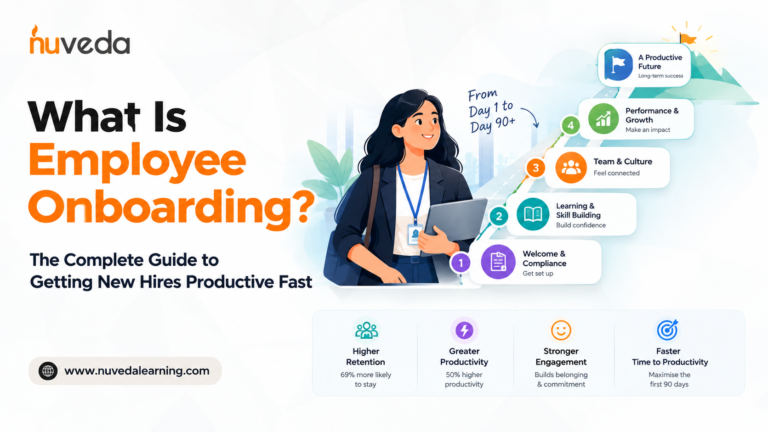
What Is Employee Onboarding? The Complete Guide to Getting New Hires Productive Fast
You have a limited window to get new-hire onboarding right. Most organisations spend that window handing over a laptop, completing paperwork, and sending a stack of PDFs.
The cost of getting it wrong can be significant. BambooHR's 2023 onboarding research found that 70% of new hires decide whether a job is the right fit within their first month, including 29% who make that decision within the first week. The same research found that, on average, companies have just 44 days to influence a new hire's decision to stay.
The cost of getting it right is equally important. Research from SHRM has found that employees who experience great onboarding are 69% more likely to stay with a company for three years, while organisations with a standard onboarding process experienced 50% greater new-hire productivity in the research cited by SHRM.
That gap, between what organisations are doing and what effective onboarding can achieve, is the onboarding problem. Gallup reports that only 12% of employees strongly agree that their organisation does a good job of onboarding.
This guide covers exactly what employee onboarding is, why it matters, the four phases of a structured programme, the most common mistakes to avoid, how onboarding varies across industries, and the role that the right learning management system plays in making effective onboarding scalable.
1. What Is Employee Onboarding?
Employee onboarding is the structured process of integrating a new hire into your organisation, covering everything from their first interaction after accepting an offer through to the point at which they are fully productive, connected to the culture, and clear on what success looks like in their role.
Onboarding is not the same as orientation. Orientation is typically a single event, often on day one or during the first week, covering administrative setup, policy briefings, and introductions. Onboarding is the broader journey: the weeks and months of structured support, role-specific training, cultural integration, performance feedback, and relationship-building that help turn a new employee into a confident and productive member of the team.
The 4 C's framework: Compliance, Clarification, Culture, and Connection, developed by Dr. Talya Bauer for the SHRM Foundation, provides a useful structure for what effective onboarding should cover.
Onboarding vs Orientation vs Induction
These terms are used interchangeably in many organisations, but they describe different parts of the employee experience:
- Orientation: A one-time event, typically covering administrative setup, HR policies, and basic introductions. Necessary but insufficient.
- Induction: Used more commonly in the UK and Australia to describe a similar process of introducing the organisation, the role, and its rules.
- Onboarding: The broader programme, beginning before Day 1 and continuing through the first several months and beyond. Orientation and induction are components of onboarding, not synonyms for it.
Gallup's research highlights this distinction: onboarding should go beyond basic setup and help employees understand their role, connect with their team, and develop a sense of belonging.
2. Why Onboarding Is a High-Leverage HR Investment
Most organisations treat onboarding as an administrative process. The evidence suggests it has a much broader impact on retention, productivity, engagement, and employee experience.
The Retention Impact
Employees who experience great onboarding are 69% more likely to stay with a company for at least three years, according to research cited by SHRM. SHRM also reports that new employees who went through a structured onboarding programme were 58% more likely to remain with the organisation after three years.
This makes the first months of employment an important opportunity to establish clarity, connection, and confidence.
The Productivity Impact
SHRM reports that organisations with a standard onboarding process experienced 50% greater new-hire productivity in the research it cites.
The productivity benefit is not simply about completing training faster. Effective onboarding helps employees understand their responsibilities, access the systems and resources they need, build relationships with colleagues, and understand how their work contributes to organisational goals.
The Commitment Multiplier
Effective onboarding also contributes to an employee's sense of belonging and commitment. Gallup's research emphasises that successful onboarding should help employees connect with the organisation's purpose and values, understand how their strengths contribute to their role, and build relationships within their team.
The Window Is Narrow
BambooHR's 2023 research found that 70% of new hires decide whether a job is the right fit within their first month, with 29% making that decision within the first week. The research concluded that companies have an average of 44 days to influence a new hire's long-term retention.
The implication is clear: what happens during the first few weeks matters. Onboarding should therefore be designed as an ongoing employee journey rather than a checklist that ends after the first day or week.
3. The Four Phases of Effective Employee Onboarding
An effective onboarding programme can be structured across four phases: pre-boarding, Day 1, Week 1, and the 30-60-90-day ramp, with support structures continuing beyond the first three months where appropriate.
Phase 1: Pre-boarding: Offer Acceptance to Day 1
Pre-boarding is one of the most overlooked phases of onboarding. The period between offer acceptance and the start date is an opportunity to replace uncertainty with connection and preparation.
Effective pre-boarding includes:
- A warm, personalised welcome message from the direct manager
- A clear Day 1 schedule so the new hire knows what to expect
- Early completion of administrative tasks, paperwork, IT setup, and access credentials
- An introduction to a pre-assigned buddy or mentor
- Cultural content, team introductions, company values, and relevant background
- Information about what the new hire should prepare before their first day
Onboarding buddies can also make a measurable difference. Research published by AAPL found that new hires with onboarding buddies reported 23% greater satisfaction after their first week and 36% greater satisfaction at 90 days compared with those without buddies.
Phase 2: Day 1: First Impressions That Stick
The first day sets the tone for the employee's experience.
A well-designed Day 1:
- Has a structured schedule with no unnecessary dead time
- Ensures equipment, accounts, and essential systems are ready
- Includes a genuine welcome from the manager and team
- Covers information that is immediately relevant
- Introduces the employee to the people they will work with
- Ends with clarity about what the first week will look like
What to avoid on Day 1: overwhelming the new hire with policy documentation, leaving them without clear points of contact, or making administrative setup so chaotic that the first impression is of organisational dysfunction.
BambooHR's research found that 62% of employees said their first impressions of a company were still accurate, while 60% agreed that first impressions are difficult to change.
Phase 3: Week 1: Orientation and Early Connection
The first week transitions from first impressions to foundation-building.
The goal is for the new hire to finish week one with:
- A clear understanding of their role and team's priorities
- A clear understanding of their manager's expectations
- Working access to the tools and systems they need
- Meaningful connections with colleagues
- An understanding of the organisation's culture and values
- A shared 30-60-90-day plan reviewed with their manager
BambooHR found that 97% of employees consider training on the tools and software they use important during onboarding, while 81% consider it crucial.
Role-specific training should begin early, but it should not dominate the entire experience. New hires also need time to build relationships, understand the culture, and ask questions.
Phase 4: The 30-60-90-Day Ramp: Learn, Contribute, Lead
A 30-60-90-day onboarding plan breaks the new-hire journey into clear phases with defined expectations and milestones.
- Days 1–30: Learn
The focus is on understanding the organisation, meeting key stakeholders, learning core processes and systems, and building the foundational knowledge required for the role. - Days 31–60: Contribute
The new hire begins applying their skills to real projects under appropriate guidance. Manager check-ins shift toward performance, feedback, and practical application. - Days 61–90: Lead
By day 90, the new hire should be operating with increasing independence and demonstrating early contributions. They should be able to complete core tasks with less supervision, contribute to team discussions, and identify opportunities for improvement.
The 90-day review should not be a pass/fail gate. It should be a structured conversation about what is working, what development is needed, and what the next milestone looks like.
Manager involvement remains critical throughout this period. Gallup's research highlights the importance of managers in helping employees understand expectations, build relationships, and develop a sense of belonging.
4. The 4 C's Framework: What Every Onboarding Programme Must Cover
The 4 C's framework: Compliance, Clarification, Culture, and Connection, provides a useful structure for what an effective onboarding programme should address.
Compliance
The legal and procedural baseline: employment contracts, health and safety requirements, data protection policies, regulatory certifications, and mandatory training.
Compliance training delivered as passive content - policies to read, slides to click through, boxes to tick - produces completion records, but completion alone does not demonstrate that employees can apply what they learned.
Effective compliance onboarding uses scenario-based training that tests whether the new hire can apply a requirement in a realistic situation.
For industries with regulatory consequences for compliance failures, such as healthcare, pharmaceuticals, financial services, and food manufacturing, this distinction is particularly important.
Clarification
Does the new hire understand their role clearly enough to perform it confidently?
Clarification covers:
- Specific performance expectations for the first 30, 60, and 90 days
- How success is defined and measured
- Decision-making authority
- Working style and communication expectations
- How the role connects to the team's priorities
- How the role contributes to the organisation's wider goals
Clarification should not be a one-time conversation. It should continue throughout the 30-60-90-day period as the employee's understanding develops.
Culture
Culture is what new hires experience that tells them whether an organisation's stated values match its actual behaviour.
Cultural integration cannot be achieved through a values presentation alone. It happens through experiences: observing how decisions are made, how conflicts are resolved, how leaders behave, and how feedback is given.
Designing onboarding for cultural integration means creating structured opportunities for new hires to observe and participate in real team interactions.
Connection
Connection to the team, to a mentor or buddy, and to the broader organisation is an important part of belonging.
BambooHR found that 87% of new hires hoped to make a friend at work, while its research also found that 93% wanted to shadow a colleague.
Connection is not created by a team lunch alone. It is created by meaningful collaboration: working on a real task together, solving a problem alongside a colleague, and contributing to team discussions.
5. The Most Common Onboarding Mistakes, and How to Avoid Them
Mistake 1: Ending Onboarding Too Early
Some organisations treat the completion of the orientation checklist as the end of onboarding.
In reality, onboarding is a longer process of helping employees understand their role, build relationships, develop capability, and become productive.
A programme that ends after the first week leaves much of that journey unsupported.
Mistake 2: Flooding New Hires With Information
New hires need a lot of information, but they do not need all of it at once.
The solution is to sequence information according to when it is needed:
- Pre-boarding: administrative setup
- Day 1: orientation essentials
- Week 1: role-specific foundations
- Weeks 2–8: deeper role and organisational knowledge
- 30-60-90 days: application, feedback, and development
BambooHR found that employees' biggest onboarding frustrations include unclear points of contact, insufficient training on company products and services, and lack of access to essential tools.
Mistake 3: No Manager Training or Accountability
A well-designed onboarding programme can fail when managers improvise its delivery.
Managers need clear guidance on their role at each phase, structured check-in frameworks, and visibility into onboarding progress.
The manager should know what the new hire needs to learn, which conversations need to happen, and what evidence will demonstrate progress.
Mistake 4: One-Size-Fits-All Content
A new graduate joining a development programme has different onboarding needs from a senior manager joining to lead an existing team.
A clinical nurse joining a hospital has different needs from a retail associate joining a store.
Effective onboarding is role-specific, level-specific, and context-specific. The 4 C's framework can apply across organisations, but the content and delivery model should vary.
Mistake 5: No Measurement
Without measurement, organisations cannot understand whether onboarding is improving retention, productivity, employee experience, or role readiness.
Track metrics such as time to productivity, 30-, 60-, and 90-day retention, new-hire satisfaction, manager satisfaction, training completion, assessment performance, and on-the-job behaviour and capability.
Mistake 6: Treating Compliance Training as Onboarding's Primary Purpose
Compliance training is necessary. It is not sufficient.
Organisations that design onboarding primarily around compliance documentation, signatures, and completion tracking may complete the required training while failing to address culture, clarification, connection, and practical capability.
The compliance gets done. The broader onboarding experience does not.
6. Onboarding Across Industries
Effective onboarding shares common principles across industries, but the design, timing, content, and delivery format must be adapted to each sector.
Healthcare
For healthcare organisations, onboarding carries clinical and regulatory stakes that make it different from general corporate onboarding.
A new nurse, allied health professional, or clinical administrator may need to demonstrate competence in specific procedures, protocols, and compliance requirements before working independently.
Healthcare onboarding can include:
- Role-specific clinical competency verification
- Scenario-based training
- Automated certification tracking
- Expiry alerts and renewal workflows
- Multi-site delivery
- Mobile-first learning for ward-based and community health professionals
The evidence: NuVeda's CALF™ platform has been used by a large eye hospital in India to certify more than 20,000 nurses and allied health professionals over seven years of continued service, using blended learning journeys, e-commerce course libraries for global access, and automated hospital onboarding workflows.
Retail
For retail deployments, onboarding must work at high volume, high speed, and on mobile.
A new store associate needs to become product-knowledgeable, customer-ready, and familiar with store procedures quickly.
Effective retail onboarding can be mobile-first and microlearning-designed, delivering the right content at the right moment:
- Product knowledge before a new range launch
- Customer-handling scenarios before the first solo shift
- Compliance checks before handling returns independently
Desktop-dependent, long-format onboarding programmes can be difficult to implement for a workforce that is on their feet, on shift, and frequently using mobile devices.
Financial Services and BFSI
For insurance, banking, and financial services, onboarding carries significant regulatory requirements.
Field agents may need certification before selling. Compliance teams may require specific training before handling sensitive client data.
Onboarding can include regulatory training, product certification, scenario-based compliance learning, regional and role-based learning paths, certification and renewal tracking, and performance analytics.
NuVeda's CALF™ platform was used by a mid-size insurance company to certify more than 15,000 agents over five years, with productivity improved by more than 50% compared to the previous manual process, according to the case study information provided for this programme.
Professional Training Companies
For training companies, onboarding is both an internal requirement and a product feature.
Training companies can use an LMS to onboard their own employees and facilitators while also providing clients with scalable, branded, measurable digital onboarding experiences.
Non-Profits and Social Enterprises
For organisations running learning programmes for staff and volunteers, onboarding often needs to support people with different levels of availability and different learning requirements.
Volunteer onboarding should be fast, self-directed, and achievable without an extended time commitment.
Staff onboarding can place greater emphasis on mission alignment, organisational culture, and role-specific capability.
7. The Role of an LMS in Employee Onboarding
The question is not simply whether to use a learning management system for onboarding. The more important question is which platform capabilities actually make onboarding effective.
What an LMS for Onboarding Must Do
- Personalised learning path delivery: Onboarding is not the same for every role, level, location, or individual. Look for platforms that support role-specific and individually adapted learning paths.
- Flexible learning journey configuration: An LMS should allow organisations to configure flexible learning journeys for different learning models, including self-paced learning, instructor-led training, and blended learning.
- Blended learning management: Effective onboarding combines digital content with manager conversations, peer interactions, structured check-ins, instructor-led training, and on-the-job application tasks.
- Mobile-first delivery: For frontline workers in healthcare, retail, logistics, and food manufacturing, desktop-only onboarding can be difficult to access. Mobile-first design, with offline capability, can be particularly valuable.
- Progress visibility for managers: Managers need visibility into new-hire learning progress without becoming LMS administrators to have timely conversations and provide support.
- Kirkpatrick Level 3 and 4 measurement: Onboarding completion rates are not onboarding outcomes. Look for platforms that connect learning activity to performance data and support on-the-job application tracking through Learning Action Plans.
- Automated compliance tracking: For regulated industries, automated certification tracking, expiry alerts, renewal workflows, and audit-ready documentation can reduce administrative work and improve visibility.
What to Avoid
- Platforms that treat onboarding as a checklist of completions
- Platforms with limited mobile capability
- Platforms that require extensive IT involvement to create new-hire pathways
- Platforms that cannot connect learning data to performance data
- Platforms that report only what learners completed rather than what they applied
8. How to Measure Whether Your Onboarding Is Working
Track onboarding success using a combination of operational, behavioural, and experience metrics.
Time to Productivity
How long does it take a new hire to reach independent performance in their role? This varies significantly by role complexity. Establish a baseline for each role, track it cohort by cohort, and monitor whether changes to onboarding produce improvements.
90-Day Retention Rate
Track what percentage of new hires remain with the organisation at 90 days. Segment results by role, manager, department, location, and hiring channel. Patterns can reveal where the onboarding experience needs attention.
New-Hire Satisfaction Surveys
Conduct short surveys at the 30-, 60-, and 90-day marks. Ask employees whether they:
- Understand their role
- Have the tools they need
- Know where to go for help
- Feel connected to their team
- Understand what success looks like
BambooHR's research highlights the importance of the first month, with 70% of new hires deciding whether a job is the right fit within that period.
Kirkpatrick Level 3: On-the-Job Behaviour
Are new hires actually performing their role correctly, rather than simply completing the onboarding checklist? Measure this through manager observation against defined competencies, Learning Action Plan completion, and early performance indicators where data is available. This provides evidence that onboarding produced capability, not just completion.
9. How CALF™ Powers Scalable, Measurable Onboarding
CALF™, Continuous Application of Learning Feedback, by NuVeda Learning is built on the conviction that feedback is what converts onboarding activities into genuine on-the-job capability.
Every element of the platform's onboarding architecture is designed to close the loop between learning and performance.
The Four-Phase Onboarding Journey in CALF™
- Pre-boarding: CALF™ can be configured to deliver pre-boarding content, welcome communications, cultural orientation, and administrative preparation before a new hire's start date.
- Role-specific learning paths: Rather than assigning the same content to every new hire by job family, CALF™ maps learning paths to specific roles and individual skill gaps, assessed through pre-programme capability checks or Nu360 360-degree feedback data.
- Flexible learning journeys: CALF™ can support self-paced, instructor-led, and blended learning journeys, allowing organisations to configure onboarding around different roles, learning requirements, and delivery models.
- Learning Action Plans: CALF™'s LAP integration bridges the gap between onboarding content and on-the-job application. New hires commit to specific, observable on-the-job actions, managers receive visibility into those commitments, and the LAP data contributes to Level 3 measurement.
- Manager dashboards: Managers can see their new hires' learning progress, LAP completion, and assessment performance, with prompts for structured conversations during the 30-, 60-, and 90-day check-ins.
- Kirkpatrick measurement: Built-in Level 3 and Level 4 measurement connects onboarding activity to behaviour change and business metrics such as time-to-productivity, retention, and performance.
- Mobile-first delivery with offline access: For frontline workers in healthcare, retail, logistics, and food manufacturing, CALF™ delivers onboarding content on iOS and Android, including offline access for workers who may not have reliable connectivity.
The Case Study: 15,000 Agents and 50% Productivity Improvement
A mid-size insurance company faced three critical onboarding challenges: rapid employee turnover that required high-volume onboarding; compliance certification for thousands of field agents distributed across multiple regions; and limited integration between its training system and HRMS.
Using CALF™, the company delivered custom blended learning journeys for agent onboarding and certification, with training analytics broken down by function, region, and cohort.
According to the case study information provided by NuVeda, more than 15,000 agents were certified over five years, with productivity improving by more than 50% compared with the previous manual process. This illustrates the value of designing onboarding as a connected, measurable programme rather than treating it as a compliance checklist.
10. Frequently Asked Questions
Employee onboarding is the structured process of integrating a new hire into an organisation, from their first interaction after accepting an offer through to becoming productive and connected to the organisation. It encompasses pre-boarding, orientation, role-specific training, cultural integration, performance feedback, and relationship-building. It is distinct from orientation, which is a single event within the broader onboarding programme.
Effective onboarding extends beyond the first day or week. For many roles, a structured 90-day onboarding plan provides a useful framework, while more complex or senior roles may require a longer period of structured support. The appropriate duration depends on role complexity, organisational context, and the level of capability required.
The four phases are: Pre-boarding (preparation, welcome communication, administrative setup, and cultural orientation); Day 1 (structured welcome, introductions, and orientation essentials); Week 1 (role clarity, system access, initial training, and early connections); and 30-60-90-day ramp (learning, contributing, increasing independence, manager check-ins, and performance conversations).
The 4 C's framework identifies four dimensions that effective onboarding should address: Compliance (legal and regulatory requirements), Clarification (role expectations and success definition), Culture (organisational values, norms, and behaviours), and Connection (relationships with the team, manager, mentor, and broader organisation).
A 30-60-90-day plan divides the new-hire ramp into three focused phases. The first 30 days focus on learning and orientation. Days 31–60 focus on contributing and applying skills to real tasks. Days 61–90 focus on increasing independence and demonstrating early performance.
A learning management system supports onboarding by delivering role-specific learning paths, configuring flexible learning journeys for self-paced, instructor-led, and blended learning, managing digital content and on-the-job tasks, providing mobile delivery, giving managers visibility into progress, automating compliance tracking, and measuring learning application rather than just completion.
Common onboarding mistakes include: ending onboarding too early, flooding new hires with information, providing insufficient manager guidance, using one-size-fits-all content, failing to measure onboarding outcomes, and treating compliance training as the primary purpose of onboarding.
Measure onboarding effectiveness using a combination of: time to productivity, 90-day retention, new-hire satisfaction, manager satisfaction, assessment results, Learning Action Plan completion, and Kirkpatrick Level 3 on-the-job behaviour.
Effective onboarding can contribute to improved retention and productivity. SHRM cites research showing that employees who experience great onboarding are 69% more likely to stay with a company for three years, while organisations with a standard onboarding process experienced 50% greater new-hire productivity in the research cited. The actual ROI will depend on the organisation, workforce, role complexity, turnover rate, and how onboarding outcomes are measured.
The Bottom Line
Only 12% of employees strongly agree that their organisation does a good job of onboarding, according to Gallup. At the same time, BambooHR's research shows that 70% of new hires decide whether a job is the right fit within their first month, while companies have an average of 44 days to influence that decision.
The organisations addressing this gap are treating onboarding as more than paperwork. They are starting before Day 1, extending support beyond the first week, covering compliance, clarification, culture, and connection, involving managers throughout the 30-60-90-day journey, and measuring whether employees can apply what they have learned.
The right enterprise LMS provides the infrastructure to make structured, measurable, scalable onboarding possible across roles, locations, and employee volumes.