
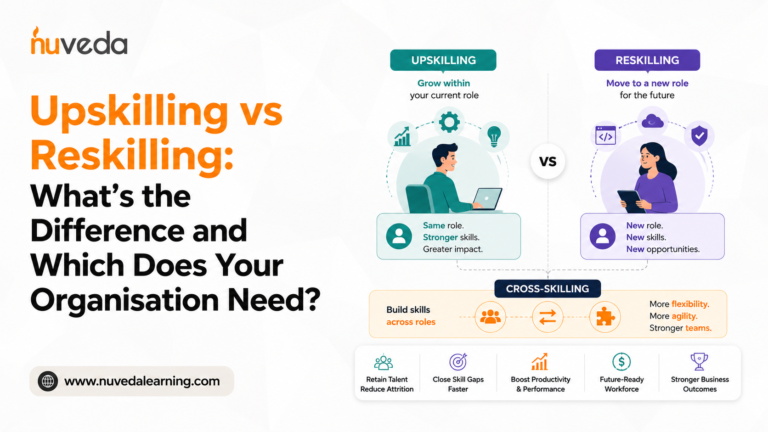
Upskilling vs Reskilling: What's the Difference and Which Does Your Organisation Need?
Upskilling and reskilling are used interchangeably in workforce planning conversations. But they solve entirely different problems, and confusing them sends L&D budgets toward the wrong targets.
The stakes for getting this right have never been higher. 59% of the global workforce will need some form of reskilling or upskilling within the next four years. AI adoption among organisations sat at roughly 50% for five years, then surged to 65% once generative AI arrived, running far ahead of any organisation's readiness curve. And skill gaps are now the single biggest barrier to business transformation, cited by 63% of employers.
Against that backdrop, misidentifying whether your people need upskilling or reskilling is not a minor planning error. It is a waste of the one resource, time, that organisations navigating AI-driven disruption can least afford to lose.
This guide gives you the clearest explanation available of what each strategy actually means, where each one applies, how to diagnose which your organisation needs right now, and how to build programmes that produce measurable skill growth, not just completion certificates.
1. Upskilling vs Reskilling: The Core Definitions
What is upskilling?
Upskilling means developing deeper expertise within an employee's existing role, closing the gap between their current capability and what the role now demands.
The employee stays in their current role. The role itself has evolved, because of new technology, new regulations, new market conditions, or expanded responsibilities, and the employee needs to build new or deeper skills to keep pace with what that role now requires.
A clear example: a customer service representative learning to work with an AI-assisted ticketing system. Same job title, same responsibilities, expanded capability.
A financial analyst learning to work with AI-driven forecasting tools is upskilling. They are not changing careers. They are evolving their ability to do the job they already hold.
Upskilling is a proactive, continuous, role-preserving strategy. It keeps your best people relevant in their current positions as those positions evolve around them.
What is reskilling?
Reskilling describes the process of developing new skills and knowledge to transition into a new job or career. If someone develops new skills with the goal of changing careers, they are reskilling.
The employee moves to a different role, because their current role is shrinking, being automated, or no longer aligned with the organisation's direction. Reskilling is the mechanism that allows organisations to redeploy talent rather than replace it when a role disappears or significantly changes.
Unlike reskilling, which prepares workers for entirely new roles, upskilling deepens expertise within a person's existing career path. A software engineer learning another coding language is upskilling. The same engineer exploring content strategy to move into a marketing role is reskilling.
Reskilling is a reactive, transition-enabling, role-changing strategy. It retains valuable institutional knowledge and organisational fit while pivoting people into roles the business actually needs.
The one-line test
Upskilling: same role, better equipped to do it
Reskilling: different role, equipped to do that instead
That difference determines which employees you target, what training you build, and how you measure whether any of it worked.
2. The Third Strategy Most Organisations Overlook: Cross-Skilling
Cross-skilling builds skills outside an employee's core job so they can flex across functions when needed. Upskilling deepens skills within someone's current role, reskilling moves them to a new one, and cross-skilling adds capabilities outside their core job entirely.
A retail store manager who learns the basics of supply chain logistics is cross-skilling. A clinical nurse who develops patient communication and digital health records skills beyond their core clinical competencies is cross-skilling. A sales manager who builds data analysis skills to self-serve reporting is cross-skilling.
Cross-skilling builds organisational resilience and workforce flexibility, the ability to redeploy people across functions quickly when demand shifts, without requiring a full reskilling programme for each transition.
In 2026, with AI reshaping job requirements faster than L&D calendars can keep up, confusing these three strategies leads to training programmes that solve the wrong problem, and that mismatch gets expensive fast.
3. Why the Distinction Matters More Than Ever in 2026
The upskilling vs reskilling distinction has always existed. What has changed in 2026 is the speed and scale at which both are required, driven primarily by one force: artificial intelligence.
AI is creating two simultaneous workforce problems
The World Economic Forum projects that AI and information-processing technologies will displace 92 million jobs by 2030 while creating 170 million new ones. Those two numbers look like good news in aggregate, net job creation, not net job destruction. But the problem is distribution: the jobs being displaced are not the same as the jobs being created, and the skills required for the new roles do not automatically exist in the people whose old roles are disappearing.
This creates two simultaneous pressures on every L&D function:
Pressure 1, upskilling at pace: Roles are not being eliminated, they are being transformed. AI adoption has surged to 65% of organisations, running far ahead of any organisation's readiness curve. Every employee whose role involves any element of information processing, customer interaction, data analysis, or content creation is facing a skill evolution demand. They need upskilling, now, continuously, and at scale.
Pressure 2, reskilling for redeployment: Some roles are being genuinely eliminated or severely reduced, particularly those involving routine tasks that AI now handles more cheaply and reliably. Early hiring data shows a 14% drop for workers aged 22 to 25 entering AI-exposed occupations like financial analyst, project manager, legal researcher, and customer service lead. The people in these roles need reskilling, a credible, supported path to a role the business will still need in four years.
Workers who can show proficiency in AI-related competencies earn on average 56% more than peers in comparable roles without those skills. The premium on the right skills has never been higher. The penalty for having the wrong ones, or for investing in development that doesn't differentiate between upskilling and reskilling, has never been steeper.
4. How to Diagnose Which Strategy Your Organisation Needs
The most common mistake organisations make is launching a development programme before diagnosing which problem they are actually solving. Here is a practical framework for getting the diagnosis right.
The four diagnostic questions
Question 1: Is the role itself changing, or disappearing?
If the role is evolving, new tools, new responsibilities, new required capabilities, but will continue to exist in a recognisable form, the answer is upskilling. The employee needs to develop within their current role.
If the role is shrinking, being automated, or being eliminated entirely, the answer is reskilling. The employee needs a path to a different role that the business will still need.
Question 2: How large is the skill gap?
Upskilling typically occurs when a job evolves due to new technology, updated processes, or expanded responsibilities. If the gap between current capability and required capability is primarily about adding depth, tool proficiency, or adjacent knowledge within a familiar domain, that is an upskilling gap.
If the gap requires learning an entirely new domain, different knowledge base, different skill set, different professional identity, that is a reskilling gap. Reskilling gaps take longer, cost more, and require stronger individual motivation to close successfully.
Question 3: Does the employee want to stay in their current path?
Career transitions often face challenges beyond just technical learning, they require psychological shifts, changing established routines, and being vulnerable to making mistakes in a new field. Reskilling against an individual's preferences and motivations produces poor outcomes. Before committing to a reskilling programme, assess whether the employee sees the new role as genuinely desirable, not just as something the organisation needs from them.
Upskilling, by contrast, reinforces rather than disrupts professional identity. People are almost always willing to become better at what they already do.
Question 4: What does your skills gap analysis actually show?
Start with a real skills gap analysis, match the strategy to the actual gap, track competency rather than completions, and tie every programme to a visible next step.
Map current skill proficiency levels against future skill requirements for each role. Where the gap is within a domain, "needs higher proficiency in skill X", you have an upskilling gap. Where the gap requires moving to an entirely different skill domain, "this person needs capability set Y, which their role has never required", you have a reskilling gap.
The decision matrix
| Scenario | Recommended strategy |
|---|---|
| New technology is changing how the role is performed | Upskilling |
| New regulations require expanded knowledge in current domain | Upskilling |
| Role responsibilities are growing without changing the core function | Upskilling |
| AI is automating 40%+ of the current role's core tasks | Reskilling |
| A role is being restructured into a fundamentally different function | Reskilling |
| Employee wants to move to a different career track | Reskilling |
| Business needs capabilities in a new area without external hiring | Reskilling |
| Team needs flexibility to cover multiple functions | Cross-skilling |
| Building succession pipeline for adjacent roles | Cross-skilling |
5. How to Build an Upskilling Programme That Sticks
The mechanics of upskilling and reskilling are different, and designing one programme to serve both produces a programme that serves neither well.
Step 1: Define the target skills precisely
Generic upskilling programmes fail because they address skill categories rather than specific skills. "Digital literacy" is not specific enough to design training for. "Can use AI-assisted forecasting tools to generate a quarterly revenue projection with scenario modelling" is specific enough. The more precisely the target skill is defined, the more precisely learning can be designed to close it.
Step 2: Assess current proficiency before designing content
Upskilling is most effective when it starts from an accurate baseline. A learner with foundational proficiency in a skill needs different content from a learner with zero exposure. Administering a pre-programme skills assessment, through scenario-based tests, manager observation, or 360 feedback data, allows you to personalise the learning path rather than delivering the same content to everyone regardless of where they start.
Step 3: Design for spaced, applied practice, not one-time exposure
The forgetting curve is the primary enemy of upskilling programmes. A two-day workshop on AI tool proficiency produces immediate awareness but minimal long-term capability, because awareness fades without reinforcement. Effective upskilling spreads development across weeks and months through spaced repetition, regular retrieval practice, and on-the-job application via Learning Action Plans.
75% of upskilled employees stay with their employer for 3+ years, compared to 42% of non-upskilled employees. But that retention premium only materialises when the upskilling actually produces durable capability, which requires design for retention, not just for delivery.
Step 4: Make the path visible to the employee
Professional development is the top driver of employee engagement at 71%. Employees who understand how developing a specific skill connects to their career progression, their performance review, and their professional future are significantly more motivated to invest in the learning. Make the connection explicit: "developing proficiency in [skill X] opens [career path Y] and increases your value in [context Z]."
Step 5: Measure skill growth, not completion
An upskilling programme that reports 96% completion rates but produces no measurable increase in skill proficiency has failed. The measurement framework must compare pre- and post-programme skill assessments, track on-the-job application of new skills, and connect skill growth to business metrics, the Kirkpatrick model of training applied at Levels 3 and 4.
6. How to Build a Reskilling Programme That Actually Works
Reskilling is harder than upskilling. It requires more time, more support, and more careful management of individual motivation and transition anxiety. The programmes that work share five characteristics.
Characteristic 1: A credible destination
Employees will only engage fully with reskilling if they believe the destination role is desirable and achievable. The business must be able to articulate clearly: what the new role looks like, what the career path from it looks like, and why the employee is a strong candidate for it. Reskilling into roles that are themselves at risk, or that have no visible growth trajectory, will produce low motivation and high attrition during the programme.
Characteristic 2: Individual motivation assessment
The business case for a reskilling programme is best measured against the cost of externally hiring and onboarding for the same role, not against doing nothing at all. But that business case only holds if the employee being reskilled transitions successfully. Before investing in reskilling, assess individual motivation through structured conversations, not just HR surveys. Employees who are enthusiastic about the new direction deliver dramatically better reskilling outcomes than those who feel they have no choice.
Characteristic 3: Structured progression with clear milestones
Reskilling into a genuinely new domain takes time, typically 6–18 months for a meaningful role change. Without clear milestones and structured checkpoints, motivation fades and the programme loses momentum. Design the learning journey with explicit phase markers: "by month 3, you should be able to [specific capability]." This maintains momentum and gives both the employee and their manager an accurate progress picture.
Characteristic 4: Manager and peer support infrastructure
Successful reskilling programmes typically involve skills gap analysis, personalised learning paths, and on-the-job mentorship. The manager's role in reskilling is more demanding than in upskilling, because the employee is navigating genuine unfamiliarity, not just extending expertise. Managers need specific guidance on how to support someone in transition: different check-in cadences, different feedback frameworks, different measures of progress.
Characteristic 5: Measurement against transition outcomes, not course completions
Track competency rather than completions, and tie every programme to a visible next step. A reskilling programme succeeds when the employee successfully transitions into the new role and performs at or above expectation. The measurement framework must track: skill proficiency growth in the new domain, successful role transition, and performance in the new role at 30, 60, and 90 days post-transition.
7. The Business Case: What the Numbers Say
The cost of not investing
Korn Ferry estimates a global talent shortage of 85.2 million people by 2030 if upskilling lags. For individual organisations, the consequence is simpler: you hire externally for roles your existing employees could have been developed into, paying recruitment costs, onboarding time, and the productivity gap of a new hire, all of which are avoidable with a proactive upskilling and reskilling investment.
The retention premium
75% of upskilled employees stay with their employer for 3+ years, compared to 42% of non-upskilled employees, and upskilled employees are 3.5 times more likely to be promoted within two years. The retention premium alone typically covers the cost of the investment: if the average cost of losing and replacing a manager is 50–150% of their annual salary, retaining even a handful of employees through upskilling investment generates a positive ROI before training effectiveness is even measured.
The career outcome evidence
US workers gained an additional 8.6% in annual income, an average of $8,000, after participating in upskilling programmes. 81% of employees who received upskilling support reported greater confidence in their role. These are not soft measures, they are signals of genuine capability growth that translate into performance and retention.
The AI skills premium
Workers who can show proficiency in AI-related competencies earn on average 56% more than peers in comparable roles without those skills. Only 10–20% of the skills required for advertised AI roles are technical, the rest are human capabilities like change agility, AI fluency, critical thinking, and psychological safety. This means the most valuable upskilling investment for most organisations is not in teaching people to code, it is in developing the human skills that allow people to work effectively alongside AI tools.
8. Upskilling and Reskilling Across Industries
Every industry faces the upskilling vs reskilling question, but the priorities and design implications differ significantly by sector.
Healthcare
For learning management system for healthcare contexts, upskilling is the dominant need: clinical protocols evolve, new medical technologies require new procedural competencies, and compliance requirements update regularly. A clinical nurse who needs to learn a new EHR system is upskilling. A healthcare administrator whose scheduling role is being automated and who is transitioning to patient coordination is reskilling.
The critical distinction matters because the design is completely different. Upskilling a nurse on a new EHR system requires short, practical, workflow-embedded learning, delivered on the ward, in the moment, on mobile. Reskilling a healthcare administrator into patient coordination requires a longer, supported programme with structured role shadowing and a defined transition timeline.
Retail
In LMS for retail contexts, upskilling is constant and urgent: new product ranges, new POS systems, new customer service protocols, and seasonal knowledge requirements mean frontline associates are continuously upskilling. The challenge is doing it at scale, quickly, and in a format that works for shift workers with no scheduled desk time.
Reskilling in retail happens when automation reduces the need for cashiers and stock handlers, and the business wants to redeploy those people into customer experience, personal shopping, or store management roles, all of which require genuinely new skills and a longer development timeline.
Financial Services and BFSI
Compliance training LMS requirements in financial services create constant upskilling demand: regulatory updates, new product requirements, and evolving disclosure obligations mean compliance knowledge must be continuously refreshed. This is upskilling, same roles, updated knowledge.
Reskilling in BFSI happens when AI-driven automation reduces the need for roles in back-office processing, document review, or routine customer service, and the business needs to redeploy those people into relationship management, advisory, or hybrid human-AI roles that require genuinely different competencies.
Professional Training Companies
For LMS for training companies, the upskilling vs reskilling question applies both to their own staff and to the programmes they design for clients. Training companies that can articulate clearly whether a client's workforce needs upskilling or reskilling, and design distinctly different programmes for each, command higher fees and produce better client outcomes than those offering generic "development programmes" that don't differentiate.
Non-Profits
For LMS for nonprofits, upskilling and reskilling are both present, often simultaneously. Field workers upskilling on new digital health data collection tools, community health workers reskilling into supervisory roles as programmes scale, and volunteers cross-skilling to cover multiple programme functions during high-demand periods. The design challenge is delivering all three effectively on minimal budget, which is where a flexible, mobile-first enterprise LMS becomes the enabling infrastructure.
9. Choosing the Right LMS for Upskilling and Reskilling at Scale
The learning management system you choose is not a neutral infrastructure decision. The right platform enables personalised, measurable skill development at scale. The wrong one produces completion data and nothing else.
Here is what to look for when evaluating a platform specifically for upskilling and reskilling programmes:
Personalised learning path capability
Upskilling programmes are most effective when learning paths are tailored to each individual's current skill level and specific gap, not when the same content is assigned to everyone in a role. Look for platforms that support skill-tagged content, pre-assessment-driven path generation, and adaptive sequencing based on learner performance.
Skills-based tracking and reporting
The platform must be able to report on skill growth over time, not just module completion. "How many employees have reached proficiency level 3 in [skill X]?" should be a report you can run in two clicks. If your best learning management system candidate cannot answer that question, it is not built for skills-based development.
Blended learning support
Both upskilling and reskilling programmes benefit from blended delivery: structured digital learning combined with practice scenarios, coaching conversations, manager check-ins, and on-the-job application. A platform that only delivers digital content, and cannot manage ILT scheduling, Learning Action Plans, and Kirkpatrick measurement in the same system, creates operational silos that undermine programme effectiveness.
Mobile-first delivery
For frontline worker upskilling (retail, healthcare, logistics, food manufacturing), desktop-only platforms fail immediately. The delivery must work on mobile, with offline access for environments without reliable connectivity, in short formats that fit into shift patterns rather than requiring extended desk time.
Integration with HRMS and performance systems
Upskilling and reskilling programmes only prove their value when skill development data connects to performance data. Look for platforms that integrate with your HRMS and performance management system, so that the connection between learning investment and measurable performance change is visible, not something your L&D team has to manually demonstrate in a spreadsheet.
Kirkpatrick Level 3 and 4 measurement
Track competency rather than completions, and tie every programme to a visible next step. The platform must support Kirkpatrick Level 3 measurement, evidence that learning translated into changed behaviour on the job, not just Level 1 and 2 satisfaction and knowledge scores. This is the evidence your CFO needs to continue investing in development, and the evidence that proves your upskilling and reskilling programmes are actually working.
10. How NuVeda's Ecosystem Powers Both Strategies
NuVeda Learning's three-product ecosystem, Nu360, CALF™, and NuCoach.ai, maps directly onto the skills development journey required for both upskilling and reskilling programmes.
Nu360, Diagnose the gap precisely
Before designing any upskilling or reskilling programme, you need to know where each individual actually stands, not just where their job description says they should be. Nu360's AI-powered 360-degree feedback framework provides multi-rater, observable-behaviour-based assessment of specific competencies, generating the data that distinguishes an upskilling gap (needs higher proficiency in an existing skill domain) from a reskilling gap (needs capability in an entirely new domain).
This diagnostic precision is what prevents the most expensive error in workforce development: designing an upskilling programme for people who actually need reskilling, or vice versa.
CALF™, Deliver personalised, measurable learning
CALF™ (Continuous Application of Learning Feedback) is NuVeda's AI-powered learning platform, the delivery and measurement infrastructure that powers both upskilling and reskilling programmes at scale.
For upskilling: CALF™ maps learning content to specific skills, delivers personalised paths based on assessed gaps, and tracks skill development through spaced reinforcement and Learning Action Plans, not just module completion. The built-in Kirkpatrick Level 3 and 4 measurement framework connects skill development to on-the-job behaviour change and business outcomes, providing the evidence chain that proves upskilling investment is working.
For reskilling: CALF™ manages longer, multi-phase learning journeys with structured milestones, blended ILT and self-paced content, manager visibility tools, and the progress tracking that both the employee and the organisation need to monitor a complex role transition effectively.
For corporate training software applications across industries, healthcare, retail, pharmaceuticals, financial services, logistics, CALF™ delivers full blended programme management on a single platform: web, tablet, iOS, and Android, with offline access for frontline environments.
For lms for training companies, CALF™'s multi-tenant, white-label capability means professional training organisations can design and deliver upskilling and reskilling programmes for multiple client organisations simultaneously, each with their own branded portal, their own skills framework, and their own measurement reporting.
NuCoach.ai, Convert learning into demonstrated capability
Both upskilling and reskilling require practice, repeated, feedback-rich application of the skill being developed in conditions that closely mirror the real job context. NuCoach.ai provides contextual AI roleplay and simulation that makes this practice available on-demand, at scale, without scheduling constraints.
A retail manager upskilling in coaching conversations can practise a difficult performance discussion with an AI persona before attempting it with a real team member. A financial services analyst reskilling into a client advisory role can practise consultative discovery conversations with realistic client personas that challenge their technique and provide immediate, competency-specific feedback.
Together, the Assess → Learn → Grow sequence, Nu360 → CALF™ → NuCoach.ai, gives organisations the complete infrastructure to diagnose, deliver, and verify both upskilling and reskilling programmes with the precision and measurement rigour that 2026's pace of change demands.
11. Frequently Asked Questions
What is the difference between upskilling and reskilling?
Upskilling means developing deeper or updated skills within an employee's current role, because the role has evolved and the employee needs new capabilities to keep pace with it. Reskilling means training an employee in an entirely new set of skills to prepare them for a different role, because their current role is changing significantly or being eliminated. The core test: if the employee stays in their current role, it is upskilling. If they move to a different one, it is reskilling.
What is cross-skilling and how is it different?
Cross-skilling builds capabilities outside an employee's core job function, enabling them to flex across roles or teams when needed. Unlike upskilling (which deepens current-role skills) or reskilling (which pivots to a new role entirely), cross-skilling builds workforce flexibility and operational resilience without requiring a full role change. It is particularly valuable in organisations that need rapid redeployment capability in response to demand shifts.
Why are upskilling and reskilling so important in 2026?
AI adoption has surged to 65% of organisations, running ahead of workforce readiness. The WEF projects AI will create 170 million new roles while displacing 92 million existing ones by 2030, but the new roles require different skills than the displaced ones. Meanwhile, 59% of the global workforce will need some form of upskilling or reskilling within the next four years. Organisations that invest in both strategies proactively, rather than reactively hiring externally for every capability gap, build workforce agility that becomes a genuine competitive advantage.
How do I know whether my organisation needs upskilling or reskilling?
Ask four diagnostic questions: Is the role changing or disappearing? How large is the skill gap, within a familiar domain or into an entirely new one? Does the employee want to stay in their current career path? And what does your skills gap analysis actually show? If the gap is about deepening capability within a current domain, you need upskilling. If it requires moving to a genuinely different skill set, you need reskilling.
What makes an upskilling programme effective?
Effective upskilling programmes define target skills precisely, assess current proficiency before designing content, design for spaced and applied practice rather than one-time exposure, make the career development path visible to the employee, and measure skill growth rather than course completion. The Kirkpatrick model at Levels 3 and 4, measuring behaviour change on the job and business outcome correlation, is the right measurement framework.
What makes a reskilling programme effective?
Effective reskilling programmes provide a credible destination role that the employee genuinely wants to move into, assess individual motivation before committing to the investment, design structured progression with clear milestones over a 6–18 month timeline, build manager and peer support infrastructure around the transitioning employee, and measure outcomes against successful role transition and 90-day performance, not course completion.
What LMS features support upskilling and reskilling programmes?
Look for: personalised learning path capability based on skills gaps; skills-based tracking that reports proficiency growth over time (not just completion); blended learning support for ILT, self-paced, and coaching elements; mobile-first delivery for frontline workers; HRMS and performance system integration; and built-in Kirkpatrick Level 3 and 4 measurement. A platform that can only report completions is not designed for measurable skills development.
How does CALF™ support upskilling and reskilling?
CALF™ (Continuous Application of Learning Feedback) delivers personalised learning paths mapped to specific skills, supports blended programme delivery across web, tablet, and mobile (with offline access), integrates Learning Action Plans that bridge training to on-the-job application, and measures skill development through built-in Kirkpatrick Level 3 and 4 reporting. Combined with Nu360 for skills assessment and NuCoach.ai for skill practice, CALF™ provides the complete infrastructure for both upskilling and reskilling programmes.
The Bottom Line
Both are workforce development strategies, but they answer different questions. Upskilling asks how to make someone better at the job they already hold. Reskilling asks how to prepare someone for a different job entirely. Choosing the wrong approach wastes time, budget, and talent.
The organisations navigating 2026's AI-driven disruption most effectively are not choosing between upskilling and reskilling; they are running both, in parallel, with the diagnostic precision to know which each individual needs and the programme design rigour to deliver outcomes that hold up beyond the completion report.
75% of upskilled employees stay with their employer for 3+ years. US workers who participated in upskilling programmes gained an average of $8,000 in annual income. Workers with demonstrable AI skills earn 56% more than peers without them.
The numbers are clear. The strategy is clear. What is needed is the infrastructure to execute it, a learning management system built for personalised, measurable skills development, not just content delivery and completion tracking.
Ready to build upskilling and reskilling programmes that produce measurable skill growth, not just completion reports? Book a free 30-minute CALF™ demo and see how NuVeda's ecosystem powers both strategies across your industry.